Ceremony
An India-Meets-Italy Wedding in Sicily: How to Blend Traditions Without Flattening Either One
·The Wedding Ring Blog Editorial Team
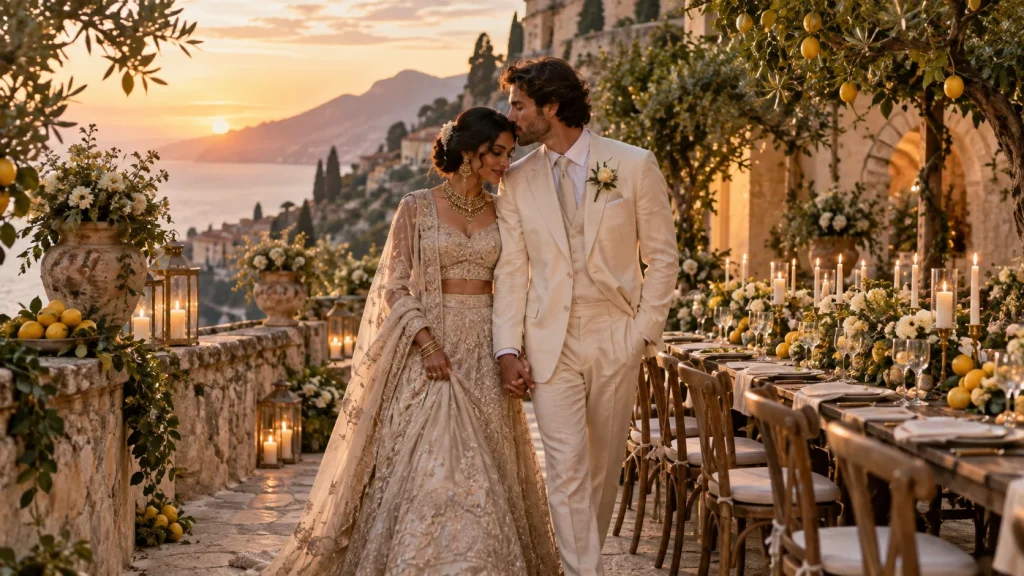
A multicultural wedding becomes shallow when meaningful traditions are reduced to colour, clothing and “fusion” décor. The stronger approach is to decide what each ritual means, who it belongs to and what guests need to understand before deciding how it will appear in the day.
This article is inspired by Vogue’s coverage of Divya Lagisetti and Holden Prosser’s wedding in Sicily, which brought Indian and Italian influences together. The point is not to copy that wedding. It is to use it as a case study in giving more than one culture enough room to feel specific.
Separate ceremony from styling
Some elements are religious, familial or culturally significant. Others are aesthetic references that can be adapted more freely. Make that distinction with the people who understand the traditions rather than treating every visible detail as decoration.
Do not force a 50/50 split into every moment
A balanced wedding does not require each ceremony, meal or outfit to contain exactly equal amounts of both cultures. One event might be led by one family’s tradition and the next by the other. The whole weekend can feel balanced even when individual moments are allowed to be themselves.
Give guests context
If a ritual will be unfamiliar to many guests, a sentence in the programme or a brief explanation from the officiant can transform it from spectacle into participation. Keep explanations concise and accurate. Avoid turning a sacred moment into a lecture.
Clothing can bridge cultures naturally
Dress can carry craft, colour and family reference while still responding to the venue and level of formality. Couples should choose garments they understand and are entitled to wear, with family guidance where appropriate, rather than using culturally specific clothing as costume.
Food is another language of welcome
Menus can move between cuisines over a weekend or make space for both without turning every dish into a mash-up. If the food has cultural meaning, explain it only where explanation adds something; guests do not need a glossary for every plate.
Use local context without erasing family context
A destination such as Sicily has its own architecture, ingredients, weather and visual rhythm. Let those qualities influence the wedding rather than importing an entirely separate theme. The result can feel rooted in the place while still centred on the families getting married.
A practical planning sequence
- List the ceremonies and traditions that are non-negotiable to each family.
- Ask who should lead or explain each one.
- Map them onto the schedule without compressing them purely for photographs.
- Choose clothing and food with the relevant family members involved.
- Use décor to support the rituals, not replace them.
Source
Vogue’s coverage of Divya Lagisetti and Holden Prosser’s Sicily wedding. This editorial case study is based on Vogue’s published reporting; the image is illustrative, not a photograph from the wedding.