Ceremony
Wedding Ring Exchange Traditions: What the Rings Symbolise and How the Ceremony Works
·The Wedding Ring Blog Editorial Team
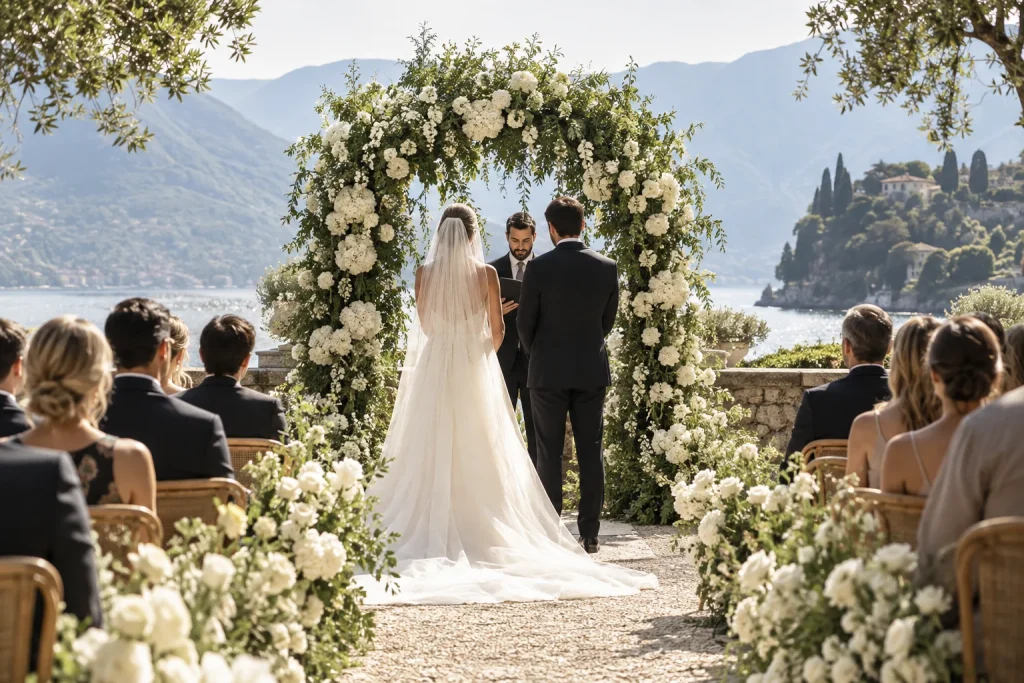
The wedding ring is one of the rare objects that appears both inside the ceremony and throughout married life afterwards. That makes the exchange more than a jewellery moment: it is a small physical ritual repeated every time the ring is noticed or touched.
Why a circle?
The circle is commonly used as a symbol of continuity because it has no visible beginning or end. That symbolism is powerful, but couples do not need to use traditional wording if it feels generic to them.
Which hand should the wedding ring go on?
Custom varies by country, religion and family tradition. In Britain and the United States the left ring finger is common, while other European and cultural traditions use the right hand. There is no universal rule that overrides your own tradition.
Who carries the rings?
- Best man or another member of the wedding party
- Ring bearer
- Officiant
- The couple themselves
- A family member as part of a ring-warming ritual
Do you need to repeat formal words?
Separate the legal marriage vows from any extra ring promise. For marriages in England and Wales, GOV.UK says vows must be exchanged and any additional wording should be discussed with the person conducting the ceremony. This is not permission to replace required words with an internet script.
The ring exchange can be optional in a civil ceremony: Portsmouth’s register-office guidance, for example, distinguishes the required statements from an optional exchange of one or two rings. Ask your own registrar or officiant what is allowed, what needs approval and when it must be submitted. Requirements differ elsewhere and in religious ceremonies.
Simple wording structures
These are ideas for an additional symbolic promise, not legal declarations or a replacement for an officiant’s required wording.
| Style | Structure |
|---|---|
| Traditional | “I give you this ring as a sign of…” |
| Personal | One sentence about what the ring will remind you of |
| Shared | Both partners use the same short wording |
| Individual | Each partner writes a different line |
| Silent | The rings are exchanged without additional spoken wording |
What is a ring warming?
In a ring-warming ceremony, the rings are passed among selected guests before the exchange so each person can hold them briefly and offer a private wish or blessing. It can be meaningful in a small ceremony but needs careful logistics in a large one.
Practical ring-exchange advice
- Remove packaging before the ceremony.
- Know who physically has the rings.
- If hands are swollen, do not force the ring.
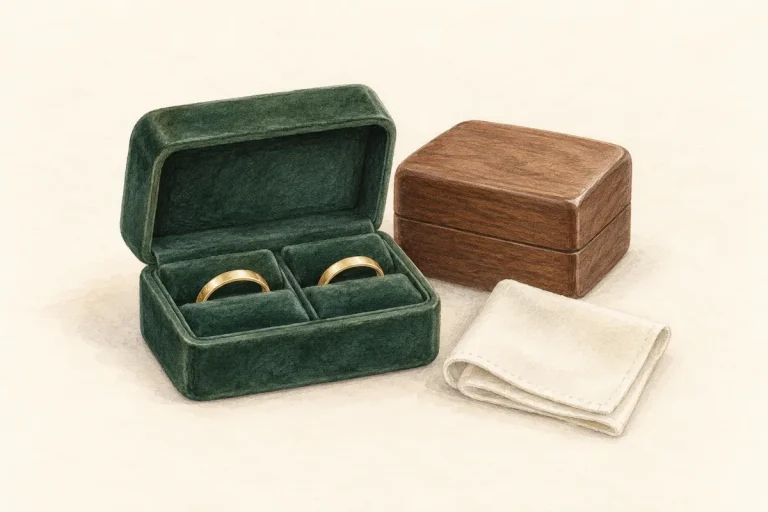
- Have a small secure ring box rather than loose rings in a pocket. Our wedding ring-box guide explains the fit, closure and handover checks.
- Tell the photographer if the ring exchange matters especially to you.
For the jewellery itself, return to our Wedding Ring Guide.
There is no single universal ring-exchange script
Ring customs vary by religion, culture, country and officiant, and some marriage ceremonies do not require a ring exchange at all. If a ritual has religious or cultural meaning, ask the relevant officiant or family members how it is normally handled rather than treating a generic internet script as authoritative. The legal requirements for the marriage itself are separate from the symbolic act of exchanging rings.
Three short ring promises to adapt
The following are original illustrative drafts. Choose words you would naturally say, then ask the officiant to approve them if necessary.
- Shared: “With this ring, I choose our life together, today and in the ordinary days to come.”
- Personal: “Let this ring remind us to keep listening, keep laughing and keep making room for each other.”
- Simple: “I give you this ring with love, and with the promise to stand beside you.”
Read your line aloud at a normal speaking pace. If a phrase sounds borrowed or too formal, simplify it. You do not need matching promises, and a longer line is not necessarily more meaningful.
Rehearse the handover, not just the words
- Agree the cue. Who asks for the rings and who brings the box forward?
- Confirm which ring is whose. If the bands look similar, agree their positions in the box before the ceremony.
- Check access. Can the holder open the box and remove the rings without tipping it? Practise over a clear table.
- Allow for a difficult fit. Do not force a ring on during the ceremony. Agree a calm alternative with the officiant in advance.
- Assign the empty box. Give it to a named person afterwards instead of leaving it at the ceremony venue.
For a ring warming, agree a supervised route and keep the rings contained. In a large gathering, a small group or a separate moment before the ceremony may be easier to manage than passing the rings through every row.