The Wedding Ring Blog
The Wedding Ring Guide
A wedding ring looks simple until you start choosing one. Metal changes the weight and maintenance. Width changes both appearance and fit. Profile changes how the band sits against the finger. An engagement ring can determine whether a straight wedding band will sit flush. Hallmarking, engraving, resizing and long-term servicing all matter after the wedding day.
This guide is designed to let you make the main decisions on one page, then use the deeper guides only where you want more detail.
If you only have five minutes
- Try real rings on. A photograph cannot tell you how 4 mm versus 6 mm feels, or whether you like the weight of platinum.
- Choose metal for maintenance as well as colour. Platinum, yellow gold, white gold, rose gold and alternative metals age differently.
- Choose width before final sizing. Wider bands contact more of the finger and can feel tighter than a narrow sizing ring.
- Choose profile for comfort and shape. Court, D-shape, flat and flat-court bands can feel very different even at the same width.
- If you wear an engagement ring, try the pair together. Check the setting height, gap, contact points and total width of the stack.
- Ask whether the exact ring can be resized. This is particularly important for full-eternity rings and many alternative metals.
- In the UK, check hallmarking where it is legally required. A hallmark verifies precious-metal fineness; it does not grade workmanship or gemstones.
- Leave enough ordering time. Bespoke work, engraving, hallmarking and resizing can add time. Ask the jeweller for the real lead time for your ring rather than relying on a generic wedding checklist.
Plan your wedding-ring budget
Compare like-for-like specifications before deciding that one ring is better value: the metal and fineness, band width and depth, stone setting, finish and aftercare should all be clear. Set a budget for each ring rather than assuming the pair must cost the same.
- Get an itemised quote: ask whether engraving, delivery and any initial size adjustment are included.
- Keep an aftercare allowance: ask about the price and availability of resizing, refinishing and any replating the particular ring may need.
- For pre-owned rings: check the stated size, condition, hallmark photographs and return terms before paying. Ask a jeweller about any proposed resizing before committing.
- Do not buy on price alone: unclear specifications, poor fit or unavailable aftercare can outweigh an apparent saving.
For price research and marketplace examples, use our UK wedding-ring cost guide. Treat advertised prices as dated examples, not a promise of what your finished ring will cost.
Step 1: Decide how the ring will actually be worn
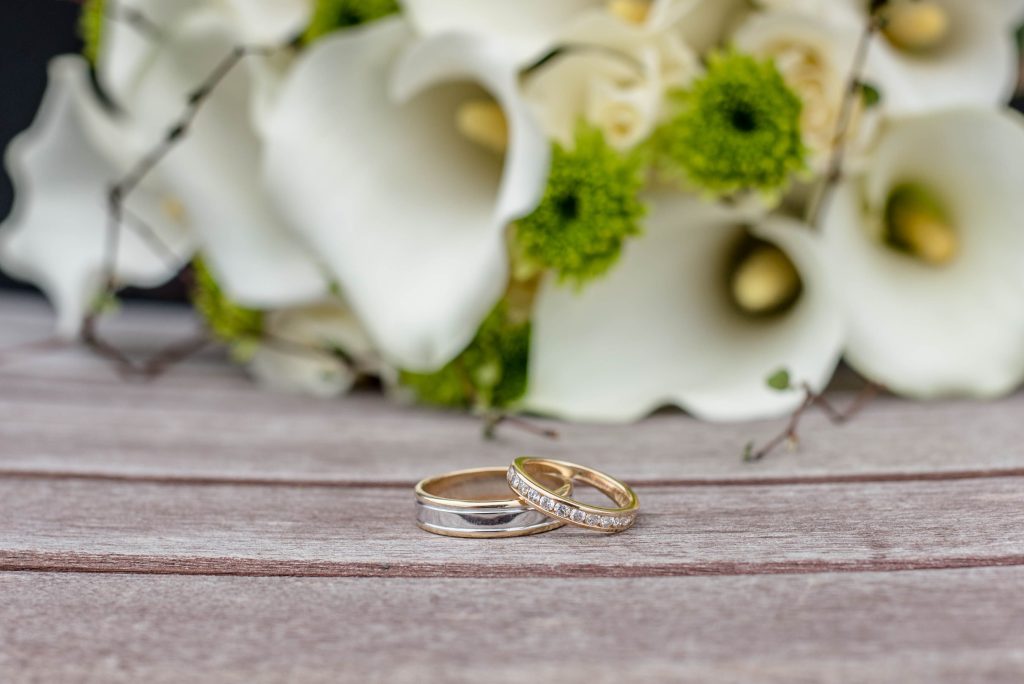
Before comparing metals or finishes, answer the practical questions. Will this be your only ring on that finger, or will it sit beside an engagement ring and later perhaps an eternity band? Do you work with your hands? Do you remove jewellery for sport, lifting, clinical work or machinery? Do you want a ring that can be refinished repeatedly, or are you happy for scratches and patina to become part of it?
The best wedding ring is not the most expensive material or the most fashionable shape. It is the one whose size, construction and maintenance fit your normal life.
Step 2: Choose the metal
Metal affects colour, density, scratch behaviour, servicing and price. It also changes how a ring feels. A 6 mm platinum band and a 6 mm titanium band may look similar in a product photograph but feel dramatically different on the hand.
| Metal | What it is like | Maintenance / wear | Resizing | Good to know |
|---|---|---|---|---|
| Platinum | Naturally white, dense and substantial | Develops surface scratches/patina; can be professionally refinished | Usually possible on plain designs, but specialist work can cost more | No rhodium plating required for colour |
| 9ct gold | 37.5% gold; available in yellow, white and rose alloys | Durable everyday option; appearance depends strongly on alloy and finish | Often straightforward on plain bands | UK fineness mark commonly 375 |
| 14ct gold | 58.5% gold; common internationally | Balances gold content and alloy properties | Often straightforward on plain bands | UK fineness mark commonly 585 |
| 18ct gold | 75% gold; richer precious-metal content | Can be polished/refinished; white gold may be rhodium plated | Often straightforward on plain bands | UK fineness mark 750 |
| 22ct gold | 91.6% gold; rich yellow colour | Softer than common lower-carat alloys; design and thickness matter | Often possible, design permitting | UK fineness mark 916 |
| Palladium | Naturally white platinum-group metal, lighter than platinum | Long-term servicing availability can be the deciding factor | Ask the exact jeweller/workshop before buying | Less commonly stocked than gold or platinum |
| Titanium | Very light, grey metal | Good corrosion resistance; can still acquire surface marks | Often limited or impractical | Useful if low weight matters to you |
| Tungsten carbide | Heavy and extremely hard | Highly scratch resistant but brittle under severe impact | Normally replaced rather than conventionally resized | Hardness is not the same as toughness |
| Stainless steel | Affordable, grey-white and hard-wearing | Easy routine cleaning; specialist finishes may be harder to restore | Often limited | Check alloy and retailer aftercare |
For a deeper comparison, read Wedding Ring Metals Explained. If you are choosing between the two most common white precious-metal looks, see Platinum vs White Gold.
White gold is not one fixed material
White gold is gold alloyed with other metals, and many white-gold rings are rhodium plated to achieve a bright white surface. Ask whether the ring is plated, which alloy system is used and what future replating is likely to involve. Do not assume every white-gold ring has the same colour or maintenance schedule.
Do not reduce metal choice to a hardness chart
Hardness, toughness, scratch resistance, ductility and serviceability are different things. A metal that resists scratching exceptionally well can still be difficult to resize or more prone to fracture under a particular type of impact. The finished ring’s thickness, profile and construction matter too.
Step 3: Choose the width
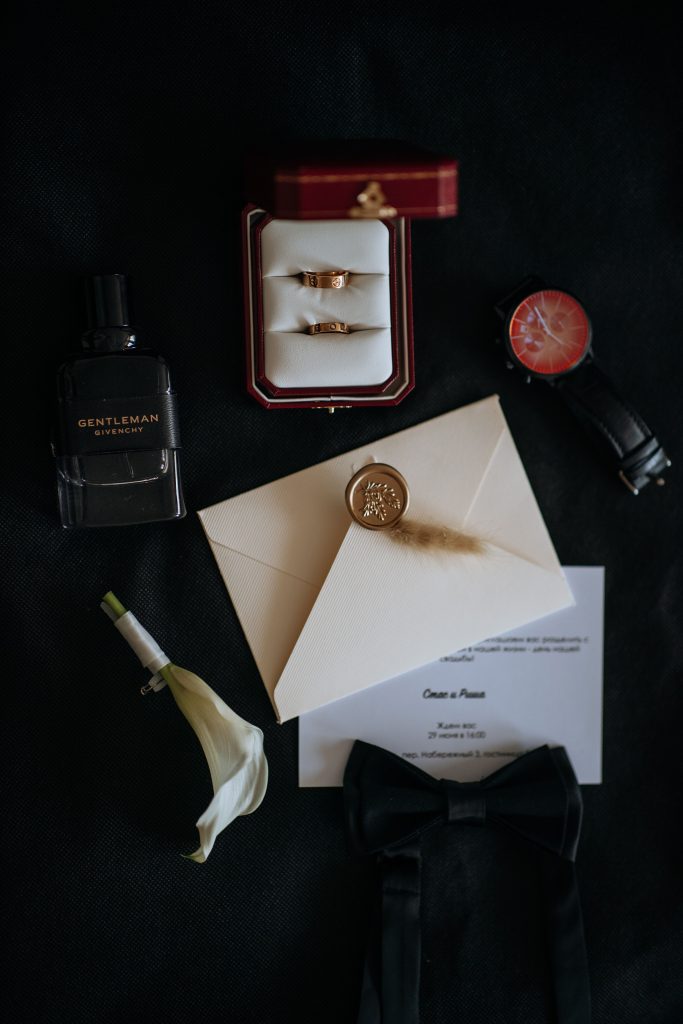
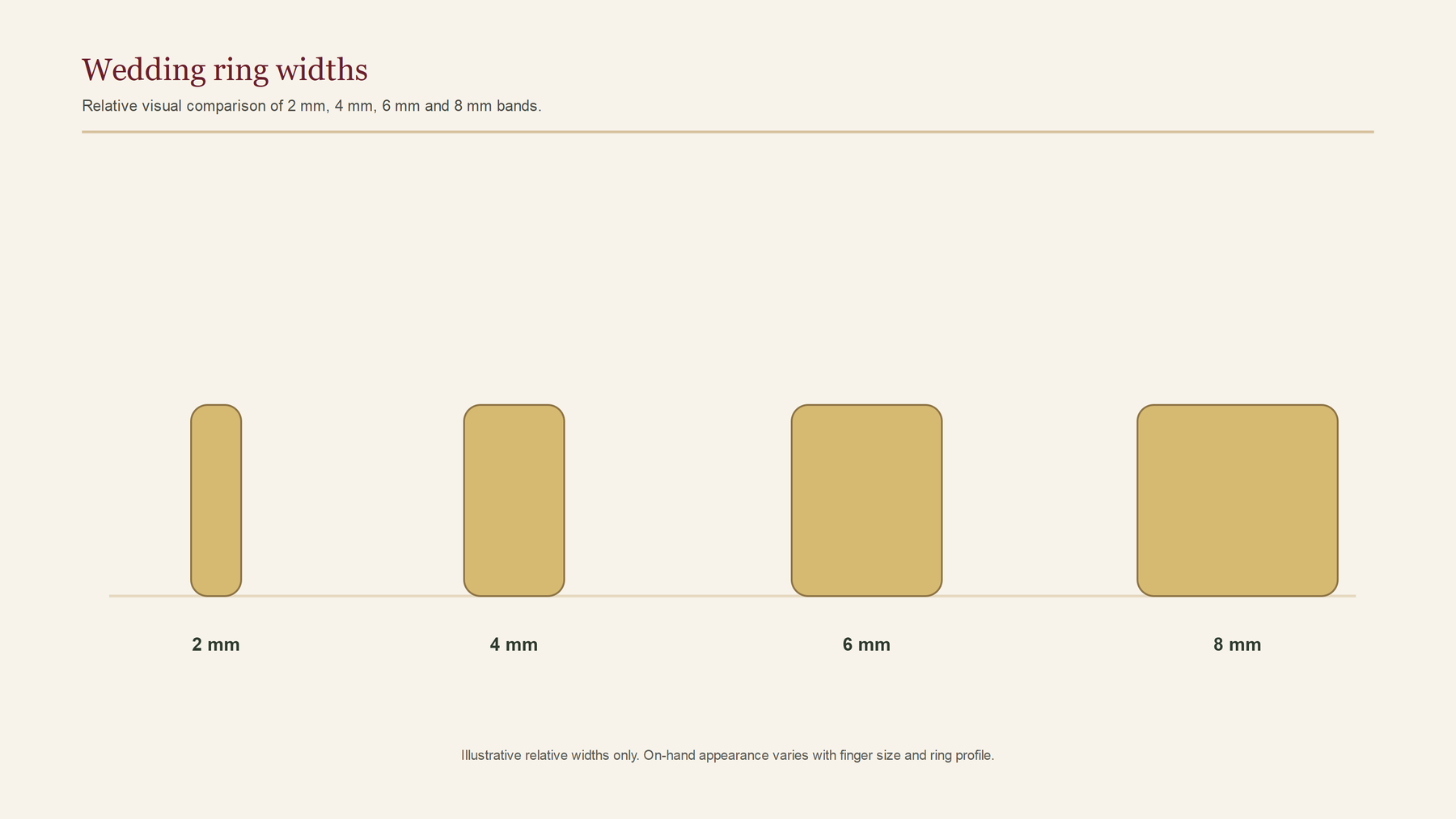
Width is measured across the band as you look down at the finger. A two-millimetre change is visually obvious and can change fit.
| Width | Typical look | What to check |
|---|---|---|
| 2–3 mm | Fine, discreet, easy to stack | Whether it looks too delicate for your hand or intended wear |
| 4 mm | Balanced reference width | A useful starting point for trying bands |
| 5–6 mm | More substantial | Knuckle clearance, neighbouring-finger comfort and sizing |
| 7–8 mm+ | Bold, architectural | Use a wide-band sizing gauge and test hand movement |
Do not choose width by gender label. Choose it by proportion, comfort, the jewellery worn beside it and the visual weight you actually like.
Read the full Wedding Ring Width Guide.
Step 4: Choose the profile
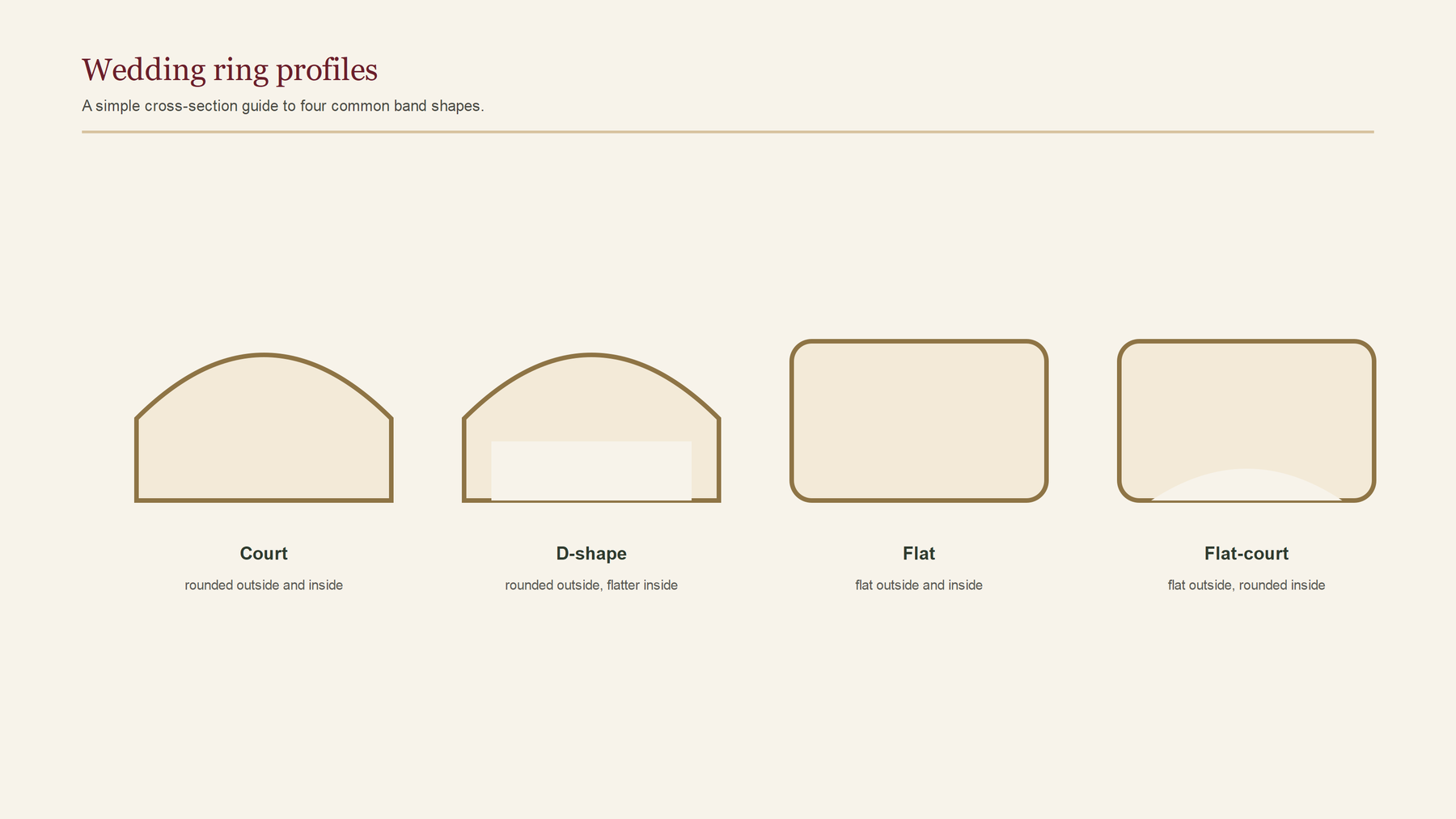
The profile is the band’s cross-sectional shape. It affects both the exterior appearance and the shape touching the finger.
- Traditional court: rounded outside and rounded inside.
- D-shape: rounded outside with a flatter inner face.
- Flat: flatter external face and a flatter or lightly eased interior.
- Flat-court: flatter modern exterior with a more rounded inside.
Names are not perfectly standard between manufacturers. Two rings described as “flat court” can still have different edge radii, thickness and inside curvature. Try the actual ring or a very close sample.
Read Wedding Ring Profiles Explained.
Step 5: Get the size right
Professional fitting is the safest approach for an expensive or difficult-to-resize ring. Finger size can change with temperature, time of day and swelling. A ring also has to pass over the knuckle without being so loose that it spins or slips off at the base of the finger.
GIA guidance recommends using finger-sizing gauges and notes that wider bands require wide-band gauges; bridal sets wider than roughly 4–5 mm need special consideration. That is why a narrow plastic sizer is useful as a first estimate but not the final word for every ring.
- Measure on more than one occasion.
- Do not measure immediately after strenuous exercise or when your hands are unusually cold.
- Use a sizing ring close to the width you intend to buy.
- If you will stack an engagement ring and wedding band, assess the combined width.
- If the knuckle is much larger than the base of the finger, ask a jeweller about fit options rather than simply choosing a smaller size.
- Before ordering an eternity or alternative-metal ring, confirm the resizing policy.
Read the complete Wedding Ring Sizing Guide.
Step 6: Match the wedding band to an engagement ring
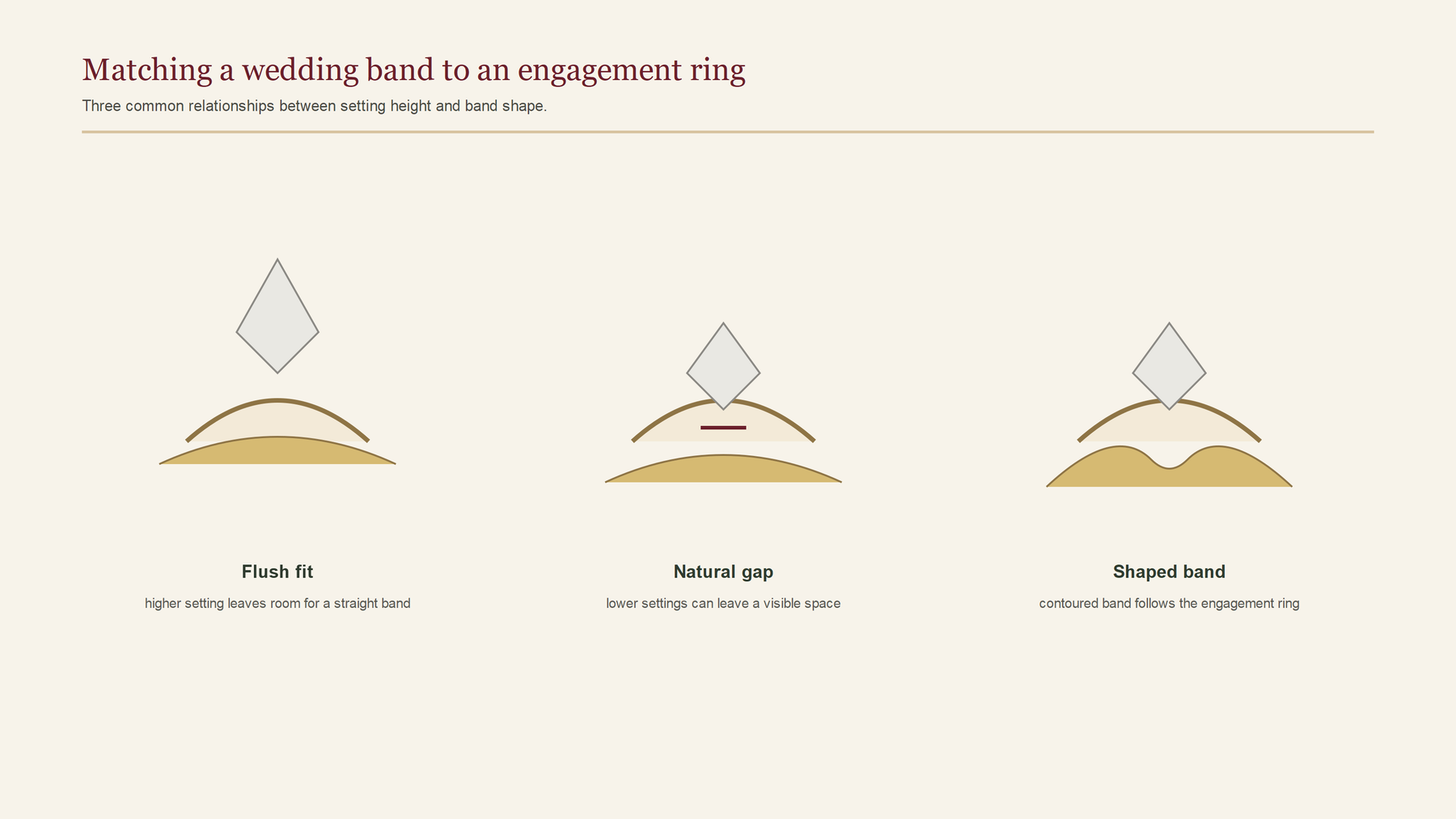
A straight wedding band will sit flush beside some engagement rings and leave a gap beside others. The deciding factor is usually the engagement ring’s side profile: the height of the centre setting, the width of its basket or gallery, projecting claws and the shape of the shoulders.
You have four legitimate choices:
- Straight and flush: possible when the engagement-ring setting leaves enough clearance.
- Straight with a deliberate gap: often looks elegant and preserves the identity of each ring.
- Contoured or curved band: follows the outline of a low or projecting setting.
- Custom fitted band: useful for asymmetric, vintage or unusually shaped engagement rings.
Do not judge the pair only from above. Look from the side and check where the metal surfaces actually touch. Rings that rub at one narrow point can wear one another over time, particularly when metals of different hardness are stacked together.
Read How to Match a Wedding Band to an Engagement Ring.
Step 7: Choose finish and surface detail
High polish reflects the most light and usually shows the first fine scratches clearly. Satin and brushed finishes reduce reflection and can make everyday marks less visually obvious. Hammered finishes use intentional surface texture, while mixed finishes create contrast between polished and matte areas.
Every finish changes with wear. Ask whether the original finish can be recreated and whether refinishing could soften engraving, milgrain or other details.
Read Wedding Ring Finishes Explained.
Step 8: Understand UK hallmarking
In the UK, qualifying articles sold as gold, silver, platinum or palladium must be hallmarked when they exceed the relevant exemption weight. GOV.UK currently lists the thresholds as:
- gold: 1 gram
- silver: 7.78 grams
- platinum: 0.5 gram
- palladium: 1 gram
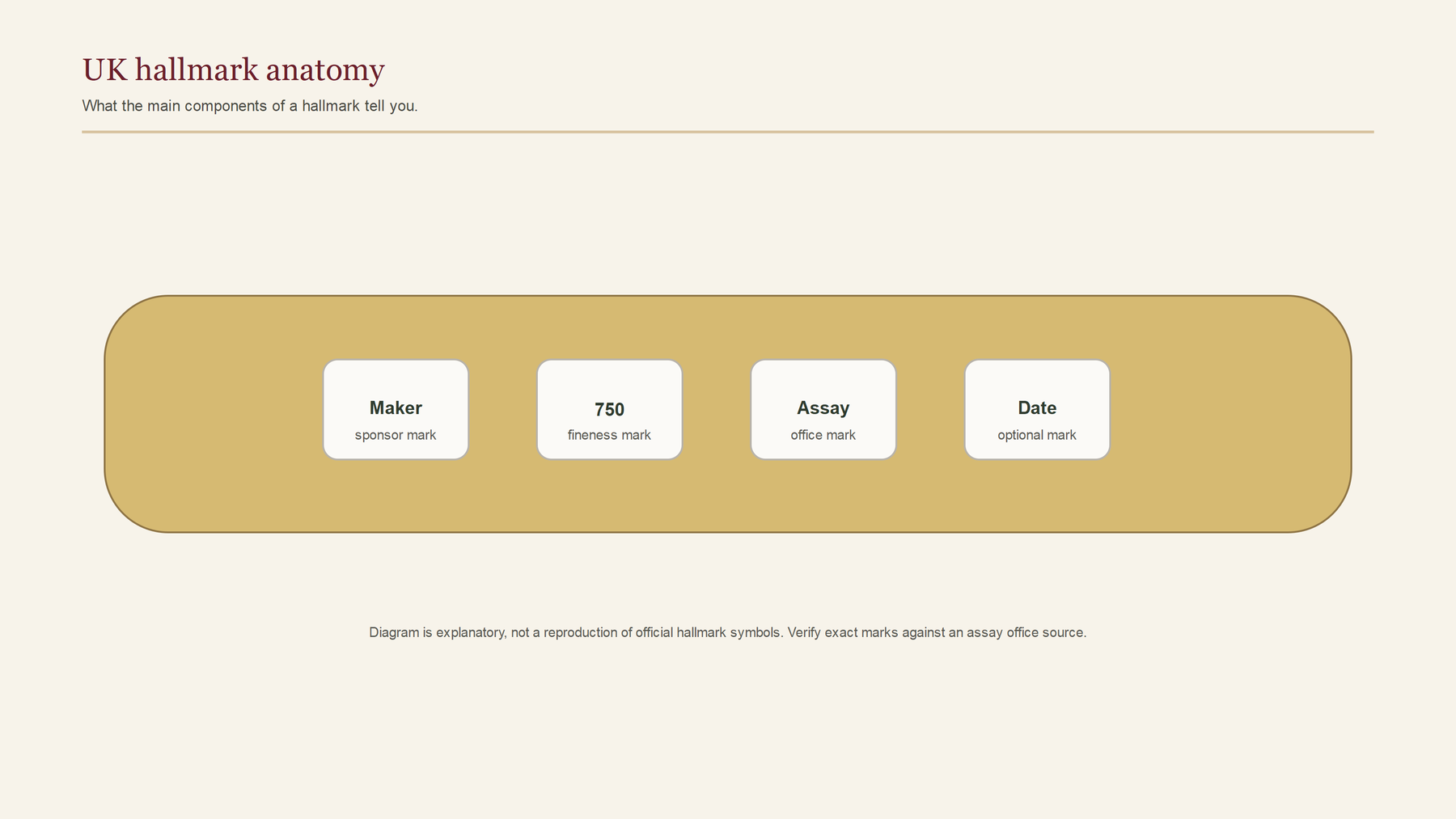
A full UK hallmark contains three compulsory elements: the sponsor’s mark, the fineness mark and the Assay Office mark. Additional traditional symbols and date letters can be voluntary.
Common fineness numbers include 375 for 9ct gold, 585 for 14ct gold, 750 for 18ct gold, 916 for 22ct gold, 925 for sterling silver and 950 for commonly encountered platinum jewellery. The shape and surrounding marks matter too; do not identify an unknown piece from one number in isolation.
Read UK Wedding Ring Hallmarks Explained.
Step 9: Think about sensitive skin before buying
Most gold jewellery is an alloy rather than pure gold, and white gold in particular can use different alloying systems. If you have a known history of reacting to jewellery, ask the jeweller exactly which metals are present and whether the white surface is plated.
Do not self-diagnose a persistent rash from an article. Irritation under a ring can have several causes, including contact dermatitis, trapped moisture, soap residue or friction. Persistent or significant symptoms should be assessed by an appropriate health professional.
Read Wedding Ring Metals and Sensitive Skin.
Step 10: Decide whether to engrave
Engraving works best when it is short enough to remain legible and personal enough to matter after the novelty has worn off. Dates, initials, short phrases, symbols, coordinates and reproduced handwriting can all work, depending on the ring and engraving method.
Confirm the final ring size before engraving where possible. Conventional resizing can interfere with an inside inscription, and narrow bands have less usable engraving height.
Read the Wedding Ring Engraving Guide.
Step 11: Plan for care, repair and size changes
Scratches are normal. Maintenance is about structural condition and wearability, not keeping a daily-wear ring permanently showroom-perfect.
- Plain gold and platinum bands can often be cleaned at home with mild soap, warm water and a very soft brush.
- Do not assume every gemstone or setting is suitable for ultrasonic cleaning.
- White-gold rings may need rhodium replating if you want to restore a bright-white plated appearance.
- Diamond-set bands should be checked if a stone moves, the ring catches unexpectedly or the setting takes a hard knock.
- Professional polishing removes material, so it should not be treated as an endlessly repeatable cosmetic routine.
Read the Wedding Ring Care Guide.
Step 12: Order early enough for the ring you actually want
There is no single correct month because jewellers and manufacturing methods vary. A stock plain band can be much faster than a bespoke shaped band, hand engraving, unusual size or custom stone-set design.
The sensible sequence is:
- Choose metal, width and profile.
- Confirm the engagement-ring fit if relevant.
- Get professionally sized using the intended width.
- Ask the jeweller for the real production and alteration lead time.
- Add a buffer for resizing, engraving or unexpected changes.
- Try the finished ring on well before the wedding day.
See When Should You Buy Wedding Rings? for a planning timeline.
Questions to ask before paying
- What exact metal, alloy and fineness is this ring?
- Will it be hallmarked, and where will the hallmark sit?
- What are the exact width and depth?
- What profile does the maker use, and can I try that profile?
- Can this exact design be resized later? By how much?
- What happens if the finished size is wrong?
- If it is white gold, is it rhodium plated?
- If it has stones, what setting is used and what routine inspections are recommended?
- Can the original finish be restored?
- Will engraving affect future resizing?
- What is the realistic production time?
- What are the return/exchange rules for personalised or made-to-order pieces?
- What aftercare does the jeweller provide?
Frequently asked questions
What is the most durable wedding-ring metal?
There is no single useful answer without defining “durable”. Scratch resistance, resistance to bending, resistance to fracture, ability to be repaired and ability to be resized are different properties. Choose the combination that suits your use rather than one headline hardness number.
Should a wedding ring match the engagement ring metal?
Not necessarily. Matching can look cohesive, while mixed metals can be deliberate and attractive. The more important practical issue is how the rings physically contact one another and whether the combination will create undesirable wear.
Do wide wedding rings need a larger size?
They often feel tighter because more metal contacts the finger. GIA recommends wide-band sizing gauges for rings wider than 4 mm. The amount of adjustment varies, so use the intended width rather than automatically adding a fixed half-size.
Is platinum better than white gold?
They solve the white-metal brief differently. Platinum is naturally white and dense; many white-gold rings are lighter and rhodium plated. Cost, feel, maintenance, alloy sensitivity and the rest of the ring design can make either the better choice for a particular wearer.
Can every wedding ring be resized?
No. Plain gold and platinum bands are often resizable, but full-eternity construction, complex patterns and many alternative metals can make resizing difficult or impractical. Ask before purchase, not after your size changes.
Where to go next
If you want to compare one decision in depth, continue with:
- Wedding Ring Metals Explained
- Wedding Ring Width Guide
- Wedding Ring Profiles Explained
- Wedding Ring Sizing Guide
- Matching a Wedding Band to an Engagement Ring
- UK Wedding Ring Hallmarks Explained
- Wedding Ring Engraving Guide
- Wedding Ring Care Guide
Sources for factual checks
Related guides
Browse the complete Wedding Ring Library →
Browse current examples
Compare wedding rings by material
Use live marketplace listings as visual references, then come back to the editorial guides for metal properties, hallmarking and fit.
Paid links. Prices, sellers and availability can change.