Rings & Jewellery
Wedding Ring Glossary: 60 Terms Explained Without the Sales Jargon
·The Wedding Ring Blog Editorial Team
Jewellery terminology becomes confusing because the same word can describe a shape, a process, a material or a marketing name. This glossary explains 60 terms that commonly appear when buying wedding and engagement rings. Where terminology varies between jewellers, we say so.
A–C
- Alloy
- A mixture of metals. Pure gold is commonly alloyed to change hardness, colour and working properties.
- Assay
- Testing used to determine the fineness of a precious-metal article.
- Assay office
- An authorised body that tests precious-metal articles and applies hallmark components. In the UK the current offices are London, Birmingham, Sheffield and Edinburgh.
- Band
- A ring whose design is primarily a continuous shank rather than a centre-stone setting.
- Bevelled edge
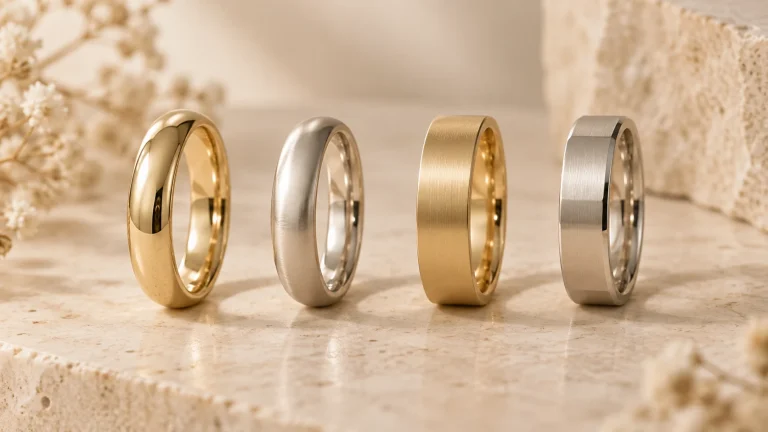
- An angled transition at the edge of a band, often used to soften the appearance of a flat profile.
- Bezel setting
- A setting in which a rim of metal surrounds all or part of a gemstone’s perimeter.
- Brushed finish
- A directional surface texture made of fine visible lines that reduces mirror-like reflection.
- Carat (diamond)
- A unit of gemstone weight equal to 0.2 grams. It does not directly describe a diamond’s face-up size.
- Carat / ct (gold)
- A UK measure of gold purity expressed in 24 parts: 18ct gold is 18 parts gold out of 24. It is unrelated to diamond carat weight.
- Channel setting
- Stones held between two parallel metal walls, usually without individual prongs between each stone.
- Comfort fit
- A general term for an inner ring surface that is rounded or eased. Exact geometry varies by manufacturer.
- Court profile
- A band rounded on both its outer and inner surfaces.
D–H
- D-shape
- A band with a rounded exterior and a flatter inner face when viewed in cross-section.
- Depth
- The thickness of a ring from the inner finger surface to the outer surface.
- Eternity ring
- A band set with a repeating sequence of gemstones across part or all of its circumference.
- Fineness
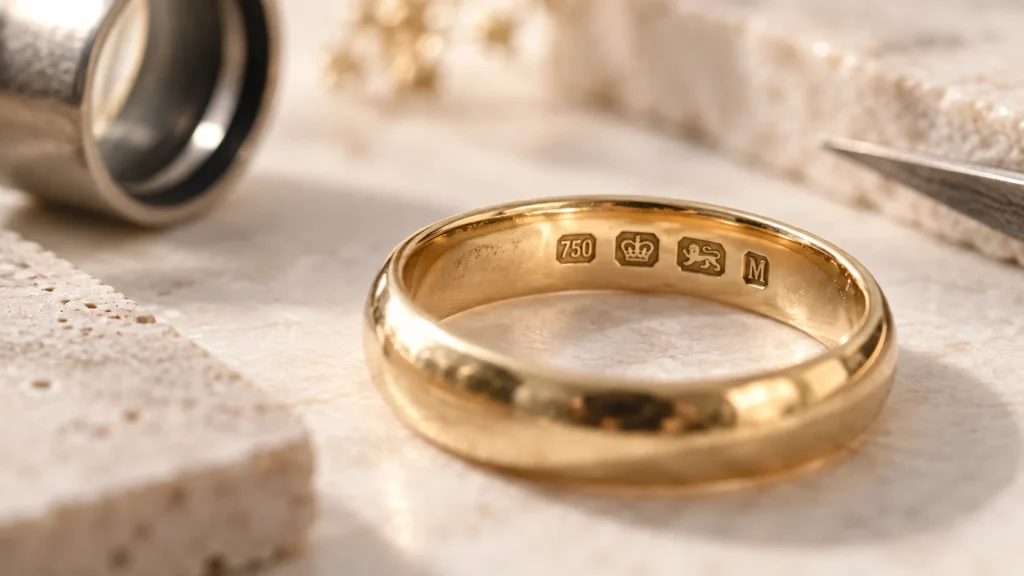
- Precious-metal content expressed in parts per thousand, such as 750 for 18ct gold.
- Fineness mark
- The hallmark component indicating the standard of precious metal, such as 375, 750 or 950 in appropriate contexts.
- Flat court
- A profile with a flatter outer appearance and a more rounded, comfort-style inner surface.
- Flush fit
- When two rings sit next to each other without a deliberate visible gap. It can also refer to a flush-set gemstone, so context matters.
- Flush setting
- A gemstone set into the metal so the top of the stone sits close to the surrounding ring surface.
- Gallery
- The structural area beneath and around a centre-stone setting.
- Grain setting
- Small beads or grains of metal raised to hold closely spaced stones, often in pavé-style work.
- Hallmark
- In the UK, a set of marks applied after independent testing that identifies fineness and other required information.
- Hammered finish
- An intentionally faceted or dimpled surface created by working the metal to produce irregular reflections.
I–P
- Inlay
- A contrasting material or metal set into a channel or recess in a ring.
- Knife edge
- A band or shank profile that rises to a relatively sharp central ridge.
- Lab-grown diamond
- A diamond produced in a laboratory rather than mined from the earth. It has the crystal structure and properties of diamond; it should be clearly described as laboratory-grown or similar.
- Milgrain
- A decorative row of tiny bead-like metal details, often used around edges or stone settings.
- Mixed metal
- A ring deliberately combining more than one metal colour or alloy.
- Mohs hardness
- A comparative scale of scratch resistance for minerals. It does not measure toughness, brittleness or overall jewellery durability.
- Palladium
- A naturally white platinum-group precious metal used in jewellery and subject to UK hallmarking requirements above the legal exemption weight.
- Patina
- The surface character that develops through wear. In platinum, fine displacement and scratching can create a softer-looking patina.
- Pavé
- A style of closely set small gemstones held with minimal visible metal, creating a paved appearance.
- Platinum
- A dense, naturally white precious metal commonly used for bridal jewellery.
- Polished finish
- A smooth, highly reflective surface produced by progressive finishing and polishing.
- Prong / claw
- A small projection of metal that bends over a gemstone to hold it in place.
- Profile
- The cross-sectional shape of a wedding band, such as court, D-shape, flat or flat court.
R–S
- Rhodium plating
- A thin rhodium coating often applied to white-gold jewellery to create a bright white surface. It can wear and may require renewal.
- Rose gold
- Gold alloyed to create a pink or reddish colour, commonly using copper as an important alloying metal.
- Satin finish
- A fine, diffuse surface texture with less reflection than a high polish. The exact appearance varies by maker.
- Setting
- The metal structure that holds a gemstone, or the method by which the stone is secured.
- Shank
- The band portion of a ring that circles the finger.
- Shoulder
- The part of the shank that rises towards a centre setting, often tapering or carrying accent stones.
- Sizing beads
- Small metal beads added inside a ring to reduce spinning or slightly tighten the fit without a full resize.
- Stack
- Two or more rings worn together on the same finger.
- Step cut
- A gemstone faceting style using long, parallel facets, seen in emerald and Asscher-style cuts.
- Sponsor’s mark
- A compulsory UK hallmark component identifying the person or organisation registered as responsible for submitting the article for hallmarking; it is not necessarily the physical maker.
- Stone spread
- An informal description of how large a gemstone appears face-up relative to its weight and proportions.
- Symmetry
- A grading or design concept describing how consistently facets, outline or components align around a centre.
T–W
- Tension setting
- A setting where the gemstone appears held between opposing sides of the ring by engineered pressure; construction and service options require specialist advice.
- Three-stone ring
- A ring with three principal gemstones, often used for symbolic or compositional reasons.
- Titanium
- A lightweight metal used for jewellery. Resizing and repair options are often more limited than for traditional precious-metal bands.
- Toi et moi
- A two-stone ring composition; the French phrase means “you and me”.
- Trillion cut
- A triangular gemstone shape, commonly used for side stones as well as centres.
- Tungsten carbide
- A very hard, scratch-resistant material used for bands. It is comparatively brittle and normally cannot be resized in the conventional way.
- White gold
- Gold alloyed with whiter metals; many white-gold rings are rhodium plated, although alloy and finish vary.
- Width
- The measurement across a band from one side edge to the other when viewed on the finger.
- Yellow gold
- A gold alloy designed to retain a warm yellow appearance; purity and alloy recipe affect colour and hardness.
- Asscher cut
- A square step-cut diamond or gemstone style with cropped corners and a geometric pattern of concentric facets.
- Cushion cut
- A broadly square or rectangular gemstone outline with softened corners; facet patterns and elongation vary considerably.
- Emerald cut
- A rectangular step-cut style with cropped corners, known for broad flashes rather than a brilliant-cut pattern.
- Oval cut
- An elongated brilliant-style gemstone shape that can provide strong face-up finger coverage for a given weight.
- Resizing
- Altering a ring’s circumference or effective fit. Feasibility depends on metal, setting, pattern, stones and amount of change.
- Wedding band
- A ring exchanged or worn in connection with marriage. “Band” describes form rather than a particular metal, width or gender.