Rings & Jewellery
Wedding Ring Thickness and Depth: The Measurement Most Buyers Miss
·The Wedding Ring Blog Editorial Team
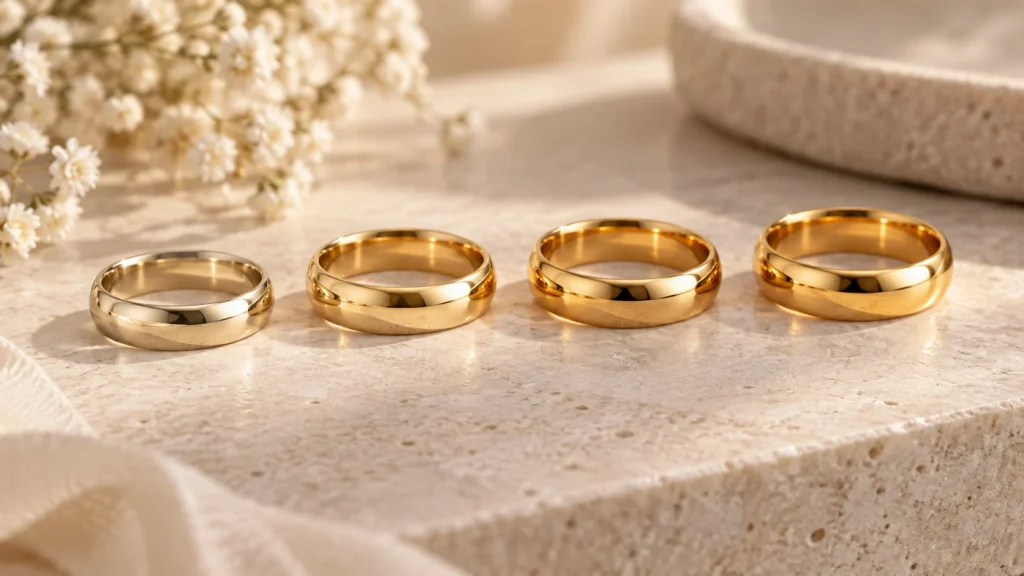
Width is the measurement most wedding-ring buyers notice first. Depth — sometimes described as thickness — is easier to overlook, even though it changes weight, durability, edge feel and the overall visual substance of the band.
Width and depth describe different things
Width runs across the finger when the ring is viewed from above. Depth describes how much material sits between the finger and the outer surface. Two 5 mm rings can therefore feel completely different.
For otherwise comparable solid bands of the same metal and size, more material generally adds weight. Hollow construction, the profile and the alloy also matter, so a weight figure alone is not proof of quality or strength.
A very thin band can look refined, but construction still has to suit the intended wear. Stone setting, engraving and long-term refinishing all need enough material to work with.
Depth affects how rings sit together
If a wedding band is much deeper than the engagement-ring shank, the pair may feel uneven or rub in an unexpected place. Compare the side profile, not only the top view.
Two rings with the same width and metal may not be equivalent if one contains substantially less material. Depth is therefore useful when comparing specification and price.
As with width, numbers are only a shortlist. The combination of width, depth, profile and finger shape determines how substantial a ring actually feels.
Depth affects comfort as well as weight
A deeper ring projects further from the finger. On some hands that feels reassuringly substantial; on others it increases contact with neighbouring fingers. Interior curvature can soften that effect, which is why depth should be considered alongside profile rather than as an isolated specification.
Most online ring photographs are taken from above or at a shallow angle because that shows the face and finish well. The side elevation — the view that reveals thickness — is often missing. If two bands appear similarly priced but one is materially lighter, depth may be part of the explanation.
Inside engraving needs enough usable space across the inner band surface; this is affected by width, curvature and existing marks, not just radial depth. Metal thickness and the engraving technique also affect what a jeweller can safely do. Ask the engraver to assess the actual ring rather than assuming a deeper band allows any design.
Diamond-set and eternity-style rings need sufficient metal around the stones and setting structure. A thin-looking design can still be technically sound, but the finished dimensions matter more than an impression from a front-facing image.
How to compare two rings properly
Write down metal, fineness, width, depth, profile and approximate weight where available. Then compare the rings on the hand. A 5 mm band that is relatively shallow may feel less imposing than a 4 mm band with greater depth and a squarer profile.
Width is covered separately in our Wedding Ring Width Guide, while the Profile Guide explains the cross-sectional shapes that interact with depth.
A useful specification to request
Ask for the finished width, depth, profile, metal fineness and approximate weight—not just a product name or front-facing photograph. Those measurements make comparisons between apparently similar rings far more meaningful.
- Try the ring beside any engagement ring.
- Check the edge against neighbouring fingers.
- Ask whether polishing or refinishing will materially change the dimensions over time.
Continue with the width guide, profile guide and buying checklist.
What thickness should a wedding ring be?
There is no single number this guide can prescribe for every metal, profile, ring size and stone setting. A plain solid band, a hollow band and a stone-set band cannot be assessed from one thickness figure alone. Ask the maker whether the finished construction is suitable for your intended wear and what repair or resizing options remain.
Product descriptions may use “depth”, “height” and “thickness” differently. Ask which direction is being measured and whether the number is the maximum at the centre of the profile or a minimum elsewhere. A domed ring does not have the same depth at every point.
A comparison record you can take to the fitting
Record these fields for each shortlisted ring. Keep the supplier’s answers with the quote so that a later order can be checked against the same specification.
- Ring reference and size
- Product code, finger size and the sizing system used.
- Metal and construction
- Alloy or fineness, and whether the band is solid or hollow.
- Width and depth
- Finished dimensions in millimetres, including where depth was measured.
- Profile and finish
- Inside and outside shape, edge treatment and surface finish.
- Weight
- Approximate weight for your size, not just the sample ring.
- Wear and aftercare
- Compatibility with the ring worn beside it, resizing limits and any care requirements.
How to use the record
Imagine two plain bands advertised at the same width. If one quote omits depth, construction and weight, you do not yet have a like-for-like comparison. Request those details before deciding that the lower price is a saving. Equally, do not assume the heavier option is more comfortable: try the rings and check contact with neighbouring fingers.
At the fitting, make a relaxed fist, hold something you normally carry and try the band beside your engagement ring if applicable. Tell the jeweller about rubbing or pressure. The goal is a ring you can comfortably wear, not the largest dimension on a specification sheet.