Rings & Jewellery
Wedding Ring Edges Explained: Bevelled, Rounded, Flat and Milgrain Details
·The Wedding Ring Blog Editorial Team
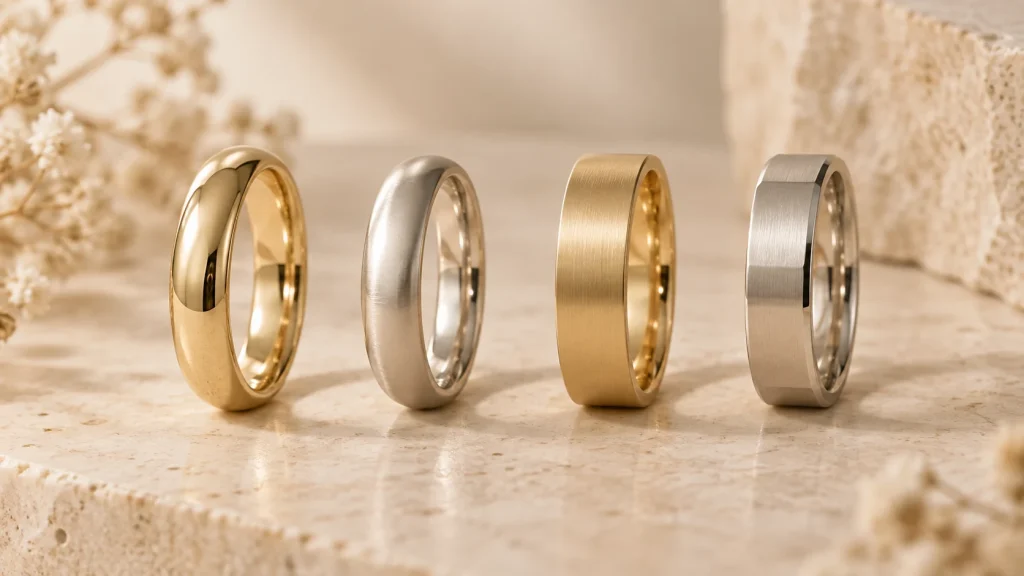
The edge of a wedding ring is a small design decision with an outsized visual effect. It determines how light catches the band, how modern or traditional the outline feels and, in some designs, how the ring sits against neighbouring jewellery.
The main edge styles
Rounded edges
Rounded edges soften the transition from the face of the band and are common on traditional court-style rings. The degree of rounding can vary considerably.
Bevelled edges
A bevel creates a deliberate angled strip along one or both sides of the band. It can add definition without changing the central face of the ring.
Flat or square edges
Sharper geometry gives a more architectural look. Comfort still depends on how the corners are finished and on the ring’s interior profile.
Milgrain
Milgrain uses a line of tiny beaded detail, often associated with vintage-inspired jewellery. It is decorative rather than structural and should be assessed for how it will wear and be restored over time.
Mixed finishes make edges more visible
A polished bevel against a satin centre, for example, creates stronger contrast than using one finish across the whole ring.
Think about refinishing
Every surface treatment changes with wear. Ask whether the original edge detail can be recreated during future servicing and whether aggressive polishing could soften it.
Edge details change apparent width
A pronounced bevel can make the central face of a band appear narrower even though the total measured width is unchanged. That is useful when comparing rings online: a 6 mm bevelled band and a 6 mm flat band may not carry the same visual weight.
Edges and neighbouring rings
If the wedding band will sit beside an engagement ring, inspect where the outer edges meet. A sharp projecting edge or raised detail can create a small contact point. A softer rounded edge may sit more forgivingly, although the engagement-ring setting remains the main determinant of flush fit.
The tiny beaded edge associated with milgrain is deliberately fine. Repeated polishing can gradually soften crisp detail, so maintenance should be conservative. Ask how the maker recommends restoring the surrounding finish without unnecessarily flattening the decorative edge.
A polished bevel around a brushed centre is a common way to create contrast without adding gemstones. The reverse can work too. Because the visual effect depends on the boundary remaining crisp, ask how refinishing is carried out later.
Choose the edge on the hand
Edge geometry is particularly difficult to judge from a flat product shot. Try to see the ring in side profile and at normal viewing distance, then move the fingers together to test whether the shape feels intrusive.
For the wider design context, compare ring profiles and surface finishes.
A five-minute comparison before you order
Keep the metal, ring size and total width the same when comparing edge designs. Otherwise you may be judging a different-sized ring rather than the effect of the edge. Request a side-profile photograph as well as the straight-on product image.
- Confirm what the width measures. Ask whether the advertised measurement is the full band, including bevels, rather than just the central face.
- Separate three decisions. The edge is the transition at the sides; the overall profile is the cross-section of the band; the finish is its surface treatment. A rounded outside edge does not, by itself, tell you whether the inside is comfort fit.
- Try ordinary movements. Close your hand gently, bring adjacent fingers together and handle a pen. Note any pressure or catching instead of judging comfort from a photograph.
- Bring the engagement ring. Ask the jeweller to check where the two rings contact, including any projecting setting. A visually matching pair is not necessarily a compatible pair.
- Record the service options. Ask whether the maker can restore the bevel or milgrain after wear, what work is included and whether resizing affects the detail.
If you are buying online, save the seller’s answers alongside the exact size, metal and edge description before placing the order. Confirm the return and alteration terms for that particular ring, especially if engraving is being added.
What refinishing can—and cannot—promise
Do not assume that every worn ring can be returned to its original shape by polishing. Suitability depends on its condition and construction. GIA’s technical guidance on refinishing worn platinum jewellery includes an example that is not suitable for refinishing. That is specialist guidance about platinum, not a rule that transfers unchanged to every metal.
For everyday ownership, follow the maker’s care instructions and let a jeweller inspect damage or a noticeably changed edge. Home abrasives are not a substitute for that assessment. See our wedding ring care guide for the broader routine.