Rings & Jewellery
Wedding Ring Metal Allergies: Nickel, White Gold and Sensitive Skin
·The Wedding Ring Blog Editorial Team
A wedding ring sits against the same area of skin for thousands of hours. If you already react to earrings, watch backs, belt buckles or fashion jewellery, the exact alloy is worth discussing before you buy.
This article is general information, not a diagnosis. A persistent, painful or spreading skin reaction should be assessed by an appropriate health professional.
“Gold” is usually an alloy
Pure gold is not the standard material for most everyday wedding rings. Other metals are added to change colour and working properties. Two rings both described as 18ct gold can therefore use different alloying recipes.
White gold is not one recipe
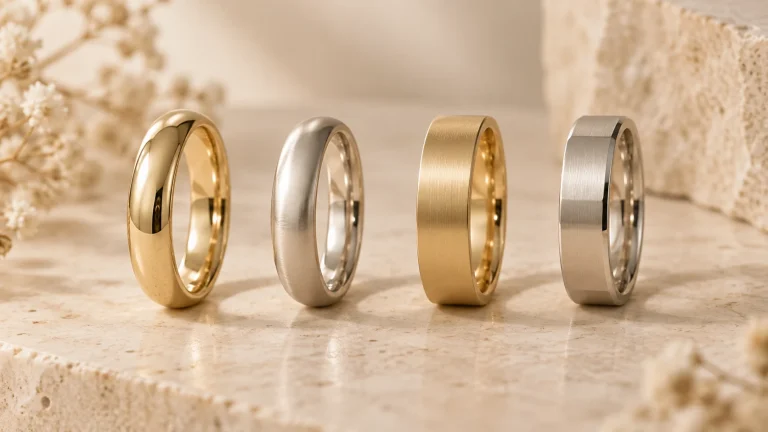
White gold may use different combinations of alloying metals. Some formulations can contain nickel; others use different systems. Many white-gold rings are also rhodium plated, which can temporarily separate the skin from the underlying alloy until the plating wears.
“Sensitive skin” is not a metal specification
Skin reactions can have several causes. The NHS explains that contact dermatitis may be irritant or allergic; metals including nickel and cobalt in jewellery can trigger allergic contact dermatitis, while soap, moisture and friction trapped beneath a ring can also irritate skin. A rash does not identify the cause by itself.
Start with the complete alloy
Terms such as gold, white gold and stainless steel describe families of materials. Ask for the alloy composition and whether any plating or surface coating is present. A high precious-metal fineness does not automatically answer every allergy question, because the remaining alloying metals still matter. “Hypoallergenic” is a marketing description unless the seller explains exactly what it means for that product.
Platinum and titanium are options, not medical guarantees
Many buyers investigate platinum or suitable grades of titanium when avoiding nickel, but no general article can promise that a particular person will tolerate a particular ring. Solder, sizing sections, decorative inlays and repair materials may differ from the main band, so ask about the whole construction rather than only the headline metal.
Do not overlook moisture and fit
A ring that is too tight can trap water, soap and residue and increase friction. Remove the ring for thorough hand drying and follow sensible cleaning guidance for the metal and any stones. If irritation improves when the ring is removed, that is useful information but not a diagnosis.
When to seek medical advice
The NHS advises speaking to a GP when symptoms are persistent, recurrent or severe. A clinician may consider contact dermatitis and, where appropriate, referral or patch testing to identify an allergen. Do not repeatedly test a suspected metal against already inflamed skin or cover symptoms with a coating and assume the underlying issue is solved.
Questions before ordering
- What is the complete alloy or recognised grade?
- Does the ring contain nickel, cobalt or a plated layer?
- Are solder and repair materials different from the main band?
- Can the maker provide the information in writing?
- What options exist if the ring causes a confirmed reaction?
Sources: NHS: contact dermatitis and British Association of Dermatologists: contact dermatitis. This guide supports a buying conversation; it is not a diagnosis or medical treatment advice.