Wedding Style
Wedding Cufflinks: Check Your Shirt Before You Buy
·The Wedding Ring Blog Editorial Team
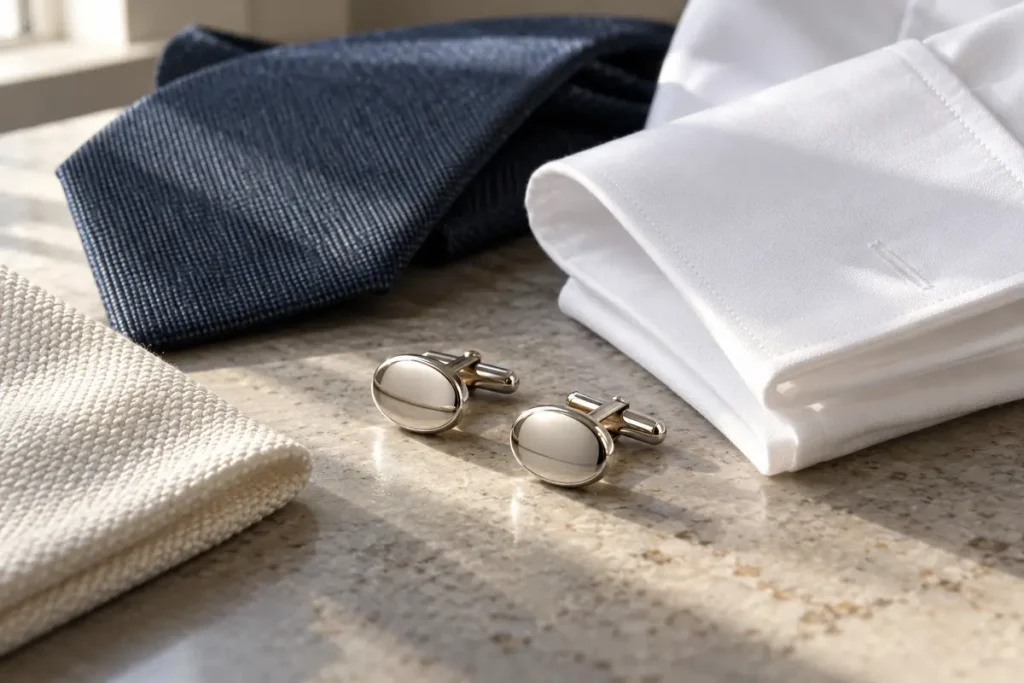
AI-generated editorial illustration, not a photograph of a tested or recommended product.
A pair of cufflinks is a small purchase with one surprisingly important compatibility check: will it work with the shirt you plan to wear? Start there, then compare the size, fastening, material and finish. The most useful wedding pair is one you can put on comfortably, wear with the whole outfit and find again when you pack for the day.
Do you actually need cufflinks for your wedding shirt?
Charles Tyrwhitt’s formal-cuff explanation distinguishes double cuffs, which fold back and fasten with cufflinks, from its single cuffs, which fasten with buttons. Look at your shirt’s actual cuff and product description before buying an accessory or changing the shirt.
You have double cuffs
Take the shirt to the fitting and try the links through the finished cuff. Check that you can operate both fastenings and that the cuff feels comfortable at the wrist.
Your cuffs fasten with buttons
Keep the shirt if it suits the outfit. Do not buy cufflinks assuming they can simply replace the buttons; confirm the cuff construction with the shirt maker first.
You have not chosen a shirt
Settle the invitation’s dress code and try the shirt with the jacket. Our Wedding Suit Guide puts those decisions in order.
For an evening wedding, use the black-tie outfit checklist before choosing finishing details. Match the shirt and links to the whole outfit at the fitting.
Compare more than the front of the cufflink
A face-on photograph can hide the parts you actually handle. Ask for the face dimensions, the distance behind the face and clear photographs of the fastening. Then compare both pieces of the pair, not just the better-looking one in the listing.
| Detail | What to check | Why it belongs in your comparison |
|---|---|---|
| Face size and shape | Measurements in millimetres and a view beside the cuff | A close-up product photograph gives little sense of scale. |
| Fastening | Both backs, their movement and the maker’s fitting instructions | You need to be able to secure and remove the exact design. |
| Material and finish | The named base material, any plating and the finish | Similar colours do not mean the same material or care requirements. |
| Engraving | The actual engraving area, proof, lead time and order terms | A generic monogram preview is not confirmation of your finished order. |
| Complete pair | Two matching pieces, condition and what the sale includes | A box or a photographed single piece does not establish the contents of the order. |
Silver-tone, plated or precious metal?
Treat colour and material as separate questions. “Silver-tone” describes an appearance; it is not a statement that a pair is sterling silver. For a plated pair, ask what the underlying material is. If the seller describes precious metal, read the stated fineness and look for the hallmark information rather than judging from a polished photograph.
UK hallmarking requirements include metal-specific weight exemptions and other exceptions. Use the British Hallmarking Council’s consumer guidance when checking a precious-metal description. A material claim is also separate from a claim about the maker, age or condition of a pre-owned pair.
Our styling starting point: a simple shape and restrained finish are easy to compare with the shirt, watch and other accessories at a fitting. If you prefer enamel, a coloured stone or a personal design, look at the complete outfit in ordinary light. There is no need to buy a matching accessory set simply because a listing bundles several pieces together.
For the complete outfit, you can also browse cufflinks at our weddingwear partner, That British Tweed Company. Check the current range, materials and fastening details against your actual shirt and suit.
Put the checks to work
Explore cufflink styles and storage
Choose a search for the job you need the accessory to do. These links open marketplace searches, not individual products we have handled or verified. Check the exact material, measurements, seller and return terms before ordering.
Affiliate links: we may earn a commission. As an Amazon Associate I earn from qualifying purchases.
Plain cufflinks
Compare a simple face, its dimensions and the fastening. Check the material description instead of treating “silver colour” as a precious-metal specification.
Black-detail cufflinks
Check whether the dark face is described as enamel, stone or another material. Compare its finish with your actual shirt and evening outfit.
A cufflink case
Check the usable compartment size against both the face and the back of the links. An existing suitable box may be all you need.
Prefer a second-hand search? Compare cufflink listings on eBay →, then use the condition checks below. Search results are not a guarantee of age, authenticity or condition.
Before paying for a pre-owned pair
Ask for both faces and both fastenings
- See the whole pair: request front, side and back photographs of both pieces in similar light.
- Ask about condition: look for differences between the two pieces, visible wear, repairs and any loose or missing details.
- Check the closure: ask whether each fastening opens, closes and holds as intended. Do not rely on a face-on photograph.
- Separate claims: maker, age and material each need their own evidence. Ask for clear photographs of marks when those claims matter to the price.
- Confirm the sale: check whether the price is for the pair, what packaging is included, delivery timing and the individual seller’s return terms.
A message to adapt: “Please could you send photographs of both cufflinks from the front and back, confirm the face dimensions and stated material, and describe any repairs or issues with either fastening?”
Do one complete try-on before the wedding
Put on the chosen shirt and cufflinks with the jacket. Check the wrist when your arm is relaxed and when you sit, reach forward or put on a coat. Try the fastening yourself; if you will need help, arrange that before the morning becomes busy.
Pack the pair together in a suitable box, with the shirt and any other small outfit pieces checked against a list. Use our wedding-suit packing checklist for the complete outfit. For the ceremony’s separate rings, the ring-box guide covers fit and handover checks.
Before you press order
- Your shirt is confirmed compatible.
- You have measurements and a clear view of the fastening.
- The material description is specific enough for your budget.
- The price covers the complete pair and any agreed personalisation.
- Delivery leaves time for a full try-on.
For another finishing detail, use our wedding pocket-square guide to compare colour, folds and pocket fit.
Continue with the complete Wedding Suit Guide or browse the Wedding Style Library for dress codes, fabrics and planning the outfit.
Sources and editorial approach
Shirt-cuff construction was checked against Charles Tyrwhitt’s cuff explanation; the precious-metal note refers to British Hallmarking Council consumer guidance. Reviewed 1 November 2026. Shopping links are discovery routes, not hands-on product reviews. How we research and review.