Rings & Jewellery
Wedding Ring Profiles Explained: Court, D-Shape, Flat and Flat-Court
·The Wedding Ring Blog Editorial Team
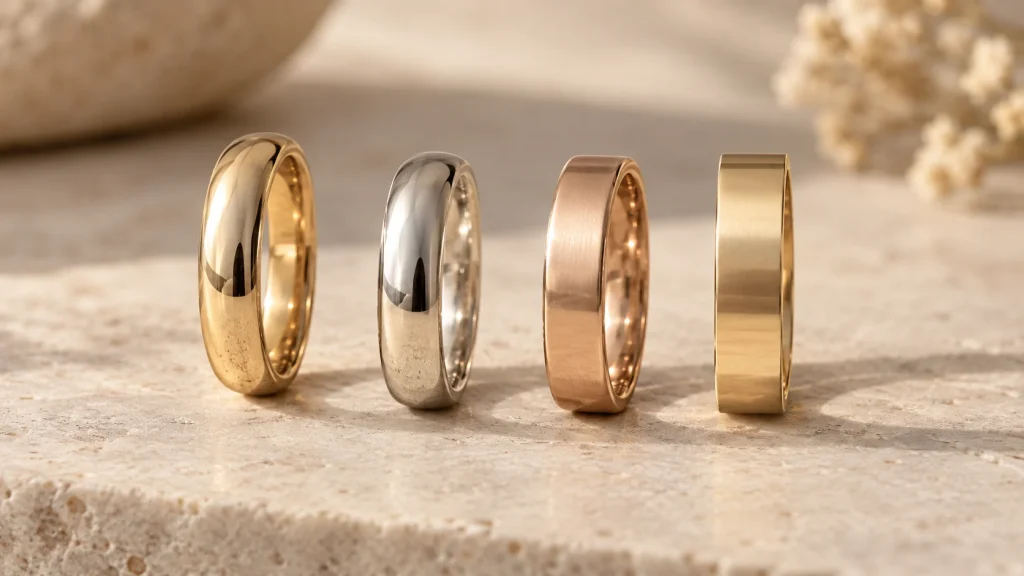
The top view does not tell the whole story. A wedding ring’s profile is its cross-sectional shape: the outside you see, the inside you feel, and the edges between your fingers.
Buying guide · Updated 16 October 2026
Try the same width in two profiles. Court and D-shape can look similar from above but feel different inside. Profile names vary between makers, so compare the actual width, depth and curves—not the product title alone.
The shape vocabulary
Four common profile families
The shapes below are simplified cross-sections, not measured product drawings. The upper edge represents the outside; the lower edge represents the inside.
Court
Rounded outside and inside. A traditional reference point with a domed outer face and a curved interior.
Try the actual depth: two court rings need not feel alike.
D-shape
A rounded outside with a flatter inner face. Its familiar exterior can resemble a court band from above.
Compare the inner contact and edges rather than assuming one is more comfortable.
Flat
A straighter, more architectural outer face. Edge treatment matters, particularly on a wide or deep band.
Ask how much the maker eases the inside and edges.
Flat-court
A flatter exterior paired with a rounded interior: a contemporary top view with a softer internal curve.
The amount of curvature and edge radius still vary by manufacturer.
Width is not depth
Width is the band across the finger. Depth is the thickness from its inner to outer surface. Two 5 mm court bands can feel different if one is shallow and the other heavily domed.
With an engagement ring, assess the complete stack. A deeper band may contact a low basket or projecting claws even when the top view looks right.
Use the width guide to compare proportions and ask a jeweller to assess the actual fit.
| Hold consistent | Ask separately |
|---|---|
| Width & ring size | What is the depth in millimetres? |
| Metal & fineness | How are the inner curve and edges shaped? |
| Your intended ring stack | Where do the rings touch when worn together? |
| Your buying budget | What is included in the finished price and aftercare? |
The seller checklist
- Measurements: confirm width, depth and ring size for the exact piece.
- Photographs: ask for the inner curve and both edges from the side.
- Fitting: can you try a sample with the same width, depth and interior?
- Terms: confirm resizing options and returns before engraving or alteration.
Keep the answer with the quote. A top-view photograph alone does not establish that a ring matches a sample tried elsewhere.
Make the comparison with your hands
Try at least two profiles in the same width. Bring neighbouring fingers together, make a gentle fist and grip a phone. Add your engagement ring if you wear one. Ask whether the profile changes the jeweller’s sizing recommendation.
A profile name is not an engineering standard. The sample and the written dimensions matter more than whether two sellers use the same label.
Make your next decision
Continue with the sizing guide, compare confirmed finished prices with the cost guide, or return to the Wedding Ring Guide. This is editorial buying guidance; ask the maker or jeweller about the actual ring’s construction.