Rings & Jewellery
Men’s Wedding Rings: A Proper Guide to Width, Metal, Finish and Design
·The Wedding Ring Blog Editorial Team
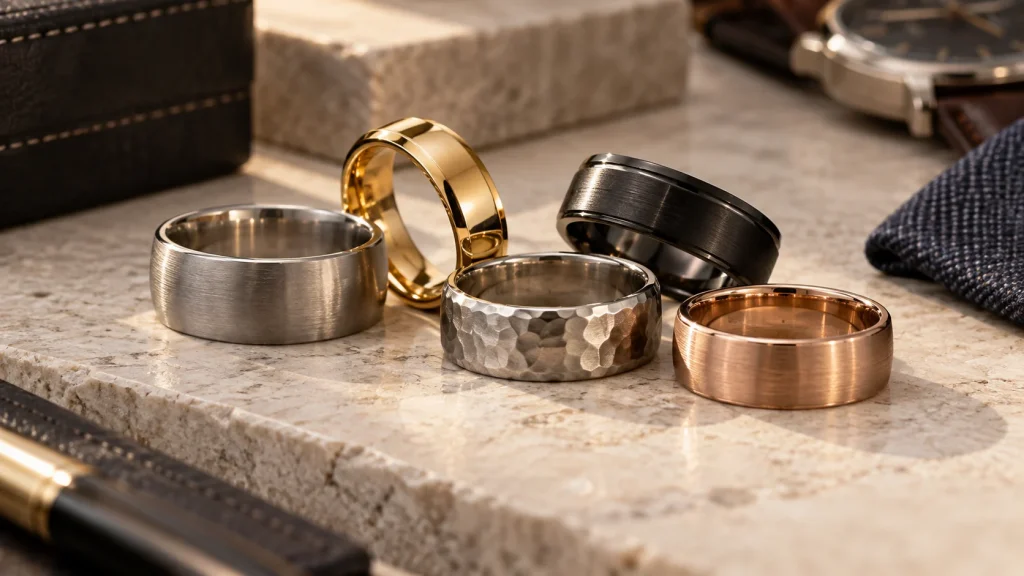
A men’s wedding ring is not a separate technical category of jewellery. The same questions apply to any band: metal, width, profile, depth, finish, fit, lifestyle and whether it can be resized. What often changes is the starting proportion, because many buyers compare wider bands and heavier-looking finishes.
Start with width
Try several widths on the same finger. A 4mm band can feel understated; 6mm is visually stronger; 8mm is substantial. Hand size is not a rule. A narrower ring can look deliberate on a large hand and a wider ring can suit a smaller hand if the wearer likes the proportion.
Remember that wider bands can feel tighter than narrow bands in the same nominal size. Use a wide-band sizing gauge where appropriate rather than guessing from an existing slim ring.
Then choose profile
- Court: rounded inside and out; traditional and comfortable for many wearers.
- D-shape: rounded outside with a flatter inner surface.
- Flat: graphic, modern appearance; edge geometry matters for comfort.
- Flat court: flatter outer appearance with a more rounded inner surface.
Metal changes both appearance and ownership
Gold and platinum are precious-metal choices with established repair and refinishing routes. Titanium, tungsten and stainless steel can offer different weights, prices and surface properties, but resizing and repair options may be limited. Ask what happens if your finger size changes in ten years, not only how the ring looks today.
Finish changes quickly in real life
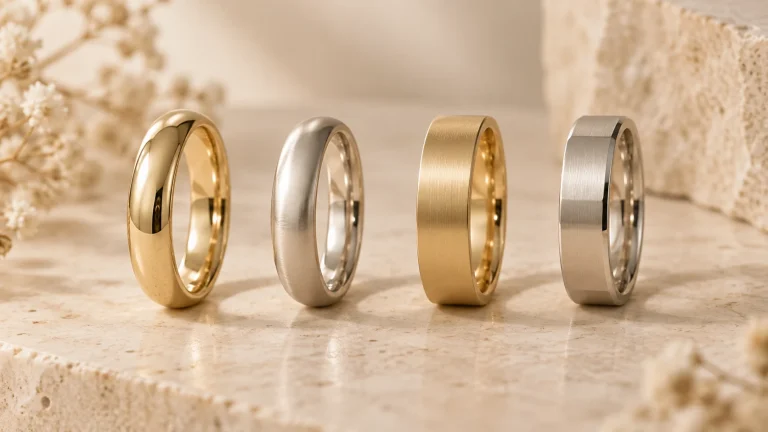
A mirror polish shows fine scratches readily. Satin and brushed finishes soften reflections but will also change with wear. Hammered surfaces can disguise minor marks while giving the band more texture. Most finishes are not permanent states; they develop with daily use and can often be refreshed depending on the metal.
Details should work at normal distance
Grooves, bevelled edges, contrasting inlays and stones can add character, but do not choose complexity simply because a plain band looks plain in a product photograph. On the hand, proportion and finish already create strong differences.
Lifestyle questions worth asking
- Do you work with tools or machinery?
- Do you lift weights?
- Do you need to remove jewellery for work?
- Will you want the ring refinished periodically?
- Is future resizing important?
No ring should be worn where workplace or equipment safety guidance says jewellery must be removed.
The best test
Wear sample bands for several minutes, make a fist, type, put your hand in a pocket and compare weights. A wedding ring is a daily object. The version that disappears comfortably into ordinary life is often a better choice than the one that wins a five-second showroom comparison.
Do not confuse hardness with toughness
Retail descriptions often reduce durability to a single word, but scratch resistance, brittleness, bending, weight and repairability are different properties. A material that resists surface marking may still crack rather than bend, while a softer precious metal may collect marks but remain straightforward for an experienced workshop to resize or refinish. Ask what damage looks like and what can be done about it.
Order only after your hands have settled
Finger size changes with temperature, time of day, activity and recent travel. Measure more than once and avoid using a narrow existing ring as the only reference for a broad band. If the design cannot be conventionally resized, the exchange or remake policy becomes part of the product and should be understood before payment.
Build the design in the right order
- Choose a comfortable width and inside profile.
- Select a metal whose weight, colour and repair options suit the wearer.
- Choose the surface finish after seeing a worn example where possible.
- Add grooves, stones, inlays or engraving only if they still improve the ring at normal viewing distance.
Use our detailed guides to compare ring profiles, surface finishes, alternative metals and engraving choices.
Plan for ordinary maintenance
Keep the purchase record and exact metal specification. Ask which cleaning methods are suitable, whether the finish can be recreated and how often settings or inlays should be checked. Remove the ring wherever workplace, sport or equipment guidance requires it; no material makes a ring safe around machinery.
Editorial shopping examples
Three live tungsten styles to compare
Selected to illustrate the design differences discussed above. These are not ranked recommendations.
A simpler polished tungsten example that contrasts with the wider and darker styles.
View on Amazon UK →Paid linkUseful as a visual example of a substantial tungsten band with a stepped matte/polished treatment.
View on Amazon UK →Paid linkA contrasting black tungsten example for readers comparing colour and surface treatments.
View on Amazon UK →Paid link