Rings & Jewellery
Stainless Steel, Titanium and Tungsten Wedding Rings: A Practical Comparison
·The Wedding Ring Blog Editorial Team
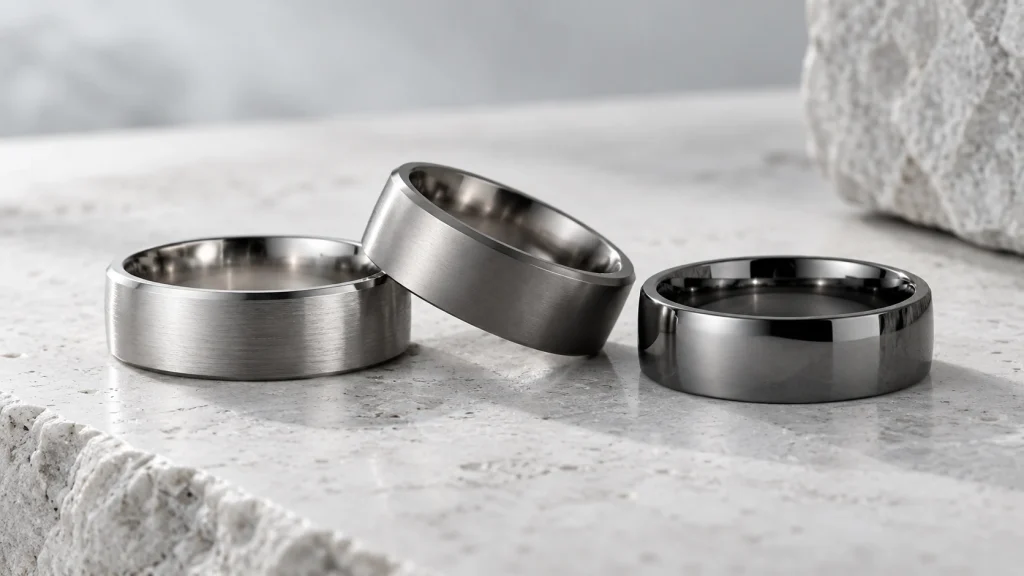
Alternative-metal wedding rings are often sold with one-word claims: titanium is light, tungsten is hard, stainless steel is durable. Those claims are broadly useful, but they do not tell you how the ring will be serviced, resized or replaced over a lifetime.
Updated 31 October 2026
Steel, titanium or tungsten: the everyday trade-offs
| Material | Feel, finish and future fit |
|---|---|
| Stainless steel | Moderate weight, usually affordable; not scratch-proof. Check the exact alloy, finish and servicing options. |
| Titanium | Very light and corrosion resistant; surface marks are possible. Conventional resizing is often limited. |
| Tungsten carbide | Substantial weight and high scratch resistance, but brittle under hard impact. Normally replaced rather than conventionally resized. |
Stainless steel
Stainless steel is affordable, strong and available in polished, brushed and darkened finishes. The exact alloy matters. If you are buying from a fashion retailer rather than a specialist jeweller, ask what aftercare exists and whether the finish can be restored.
Titanium
Titanium’s defining everyday feature is low weight. A broad titanium band can feel surprisingly light compared with gold, platinum or tungsten. That can be an advantage if you dislike noticeable jewellery.
Resizing is the main practical issue. Some designs allow limited adjustment, but buyers should assume that conventional resizing may not be available unless the maker confirms otherwise.
Tungsten carbide
Tungsten carbide is exceptionally hard and resists scratching better than common precious-metal bands. Hardness is not the same as toughness. Under a sufficiently severe impact, tungsten can crack or fracture rather than bend.
That behaviour is not automatically a disadvantage; it simply means tungsten should be chosen with realistic expectations. If your finger size changes, replacement is normally more practical than resizing.
Which material is best for manual work?
No ring is a substitute for workplace safety rules. People working around machinery, lifting, electrical hazards or environments where a ring could catch may need to remove jewellery entirely regardless of the material.
Coatings and black finishes
Black, blue or other coloured alternative-metal rings often use coatings or surface treatments. Ask whether the colour is integral to the material or a coating, and what happens when high-contact areas wear.
Five questions before buying
- Can this exact design be resized?
- If not, what is the retailer’s size-exchange policy?
- Can the original surface finish be restored?
- Is the colour a coating?
- Who can service or replace the ring later?
Compare these options with gold, platinum and palladium.
Source and further reading
GIA: ring metals for everyday wear discusses titanium’s low weight and resizing limits, and tungsten’s scratch resistance and brittleness.
Ask about replacement before choosing a difficult-to-resize ring
A size-exchange promise is useful only when you understand its conditions. Keep the seller’s written answer with your order.
- Which design is covered? Confirm the exact ring, including any coating, inlay or stones.
- What happens after engraving? Ask whether personalisation changes the available exchange or replacement options.
- What would you pay? Check postage, administration charges, replacement cost and any time limit.
- Can you try the same width? Use a sample close to the width and inside profile you intend to order.
Prepare with the sizing guide and compare the resizing limits of different designs. A retailer’s replacement service is different from altering the original ring.
Compare gold carats and construction if future workshop alterations matter more to you, or use the width guide to prepare for trying bands on.