Rings & Jewellery
Shaped and Contoured Wedding Bands: When a Straight Band Will Not Sit Flush
·The Wedding Ring Blog Editorial Team
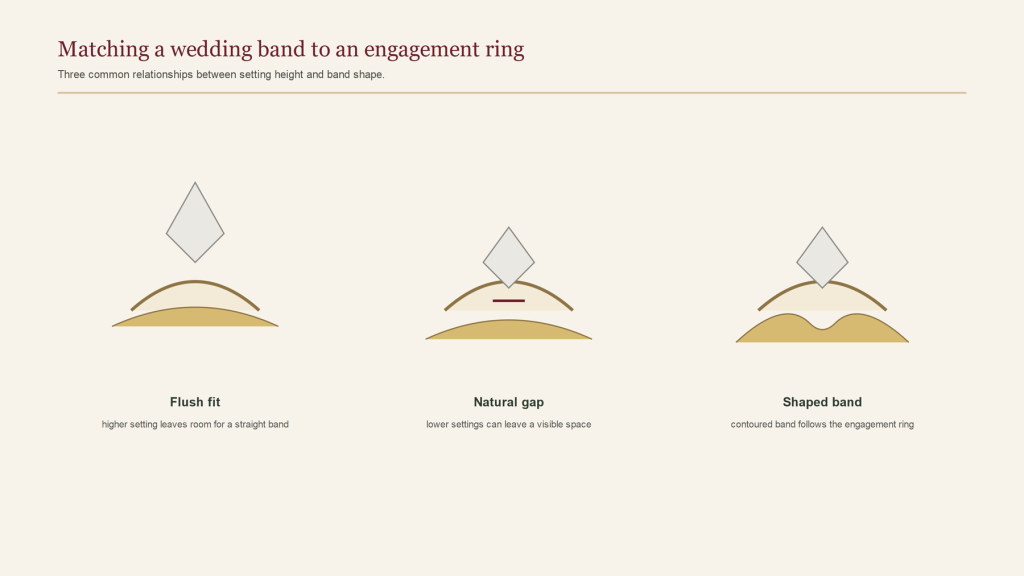
A straight wedding band is the simplest option, but it will not sit neatly beside every engagement ring. Low settings, wide baskets and stones that extend close to the finger can all create contact or a visible gap.
Updated 31 October 2026
First decide whether a gap is actually a problem
A small space between rings is not inherently wrong. Some people prefer the separation because each ring remains visually distinct. The goal is not to force every bridal set to appear fused together.
Why engagement-ring construction matters
Look at the engagement ring from the side. If the setting reaches down close to the finger, a straight band may meet the setting before it reaches the engagement-ring shank.
Common solutions
Curved, notched, chevron and custom-fitted bands create space around the engagement ring in different ways. The best choice depends on how much clearance is required and whether the wedding band should still look complete when worn alone.
Compare the shape before choosing the finish
On a phone, swipe the comparison sideways if needed.
| Option | What to compare at the fitting |
|---|---|
| A straight band with a deliberate gap | Try this first if you like seeing each ring separately. Ask the jeweller to inspect where the rings touch when your hand moves; a visible gap alone does not establish a suitable pairing. |
| A gentle curve | Compare the width and depth of the curve with your actual setting. A soft arch in a photograph may be shallower or wider than the space your ring needs. |
| A notch or cut-out | Ask for measurements of the opening and try the band alone too. A shape designed around another ring is not automatically a match for yours. |
| A chevron | Decide whether you like the point as a design feature, then check the clearance. Do not assume any V-shaped ring will fit simply because its outline looks open. |
| A custom-fitted band | Agree the exact shape, fitting process, quoted cost and approval stage before work starts. Ask what happens if the first sample needs adjustment and what alterations affect returns. |
What to take to a pairing appointment
- Your engagement ring and any other rings you intend to wear in the stack.
- A note of whether you also want to wear the wedding band by itself.
- Two or three reference shapes, plus your preferred metal, width and finish.
- Your ceremony date and time for any agreed fitting or alterations.
Ask to see the pair from the side, with your hand relaxed and while making normal movements. Ask the jeweller to identify contact points and explain whether the proposed design needs changing. Record the actual sample dimensions rather than ordering from a similar-looking photograph later.
Please confirm the wedding band’s width, depth and shaped opening, how the pair was checked for contact, the size tried, the final quoted price and the delivery or collection date.
Our sizing guide helps record fit, while the two-ring budget worksheet keeps confirmed extras separate from the ring price.
Compare outlines
Shortlist curved and chevron designs
Save candidates for a fitting, then ask for the band’s width, depth and shaped opening. A similar-looking outline does not establish compatibility with your engagement ring.
Affiliate links: we may earn a commission. As an Amazon Associate I earn from qualifying purchases.
eBay UK · Curved
Curved wedding bands
Compare the curve and its opening, plus the exact metal, dimensions and condition. Check whether the design can be returned before any alteration.
eBay UK · Chevron
Chevron wedding bands
Check how the point looks alone and beside your engagement ring. Ask for a side view and the individual seller’s sizing and return terms.
Amazon UK · Fitting visit
Keep both rings separate
For a fitting or travel, look for separate compartments with enough depth for the engagement-ring setting. Check the lining and closure.
Changing marketplace searches, not tested or authenticated recommendations. Results may include plated items or unrelated jewellery. Confirm the actual item, seller and return terms; settle fit before irreversible engraving or alterations.
Our ring-box guide covers ceremony and travel checks.
For a design example, our Zendaya east-west ring feature looks at why a striking top view still leaves practical pairing questions. The ring’s orientation is a starting point for comparison, not a guarantee that it needs a particular wedding band.
Try both rings together
This is one of the clearest cases where trying the combination is more useful than comparing isolated product photographs. Check comfort, movement and whether metal or stones are rubbing in an undesirable place.
The second fitting check
Try the wedding band on its own
Before approving a fitted shape, take the engagement ring off and check three things:
- The outline: do you still like the curve or notch as a standalone design?
- The feel: is the shape comfortable against neighbouring fingers during normal movement?
- The plan: ask the maker how future sizing or changes to the engagement ring could affect this particular pairing.
Record the sample and agreed dimensions on the printable ring comparison sheet. Settle these questions before approving irreversible work.