Rings & Jewellery
UK Wedding Ring Hallmarks Explained: What 375, 585, 750, 950 and 925 Mean
·The Wedding Ring Blog Editorial Team
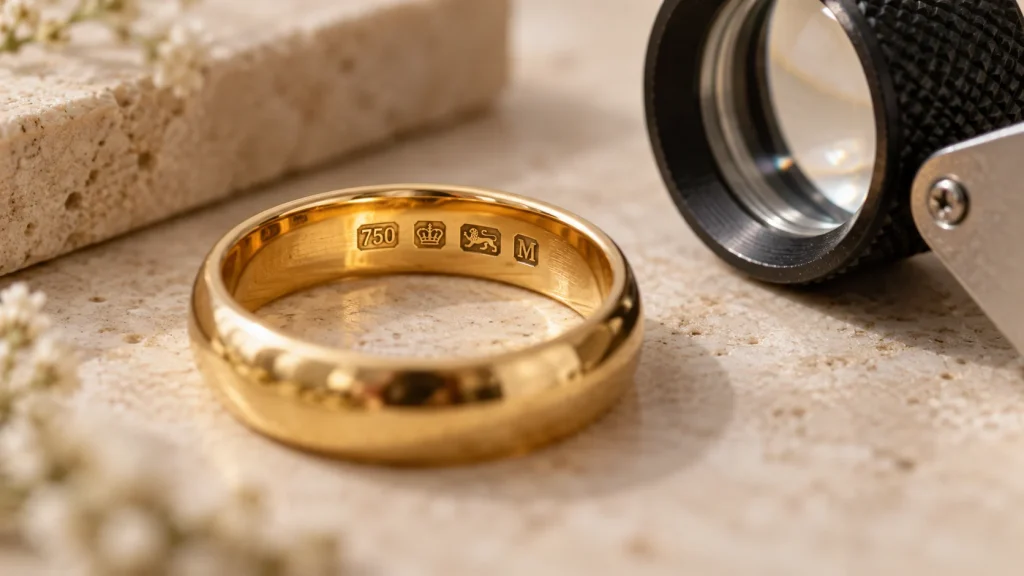
A UK hallmark is an independent verification of precious-metal fineness. It is one of the most useful checks a buyer can make because gold, silver, platinum and palladium are difficult to identify accurately by sight alone.
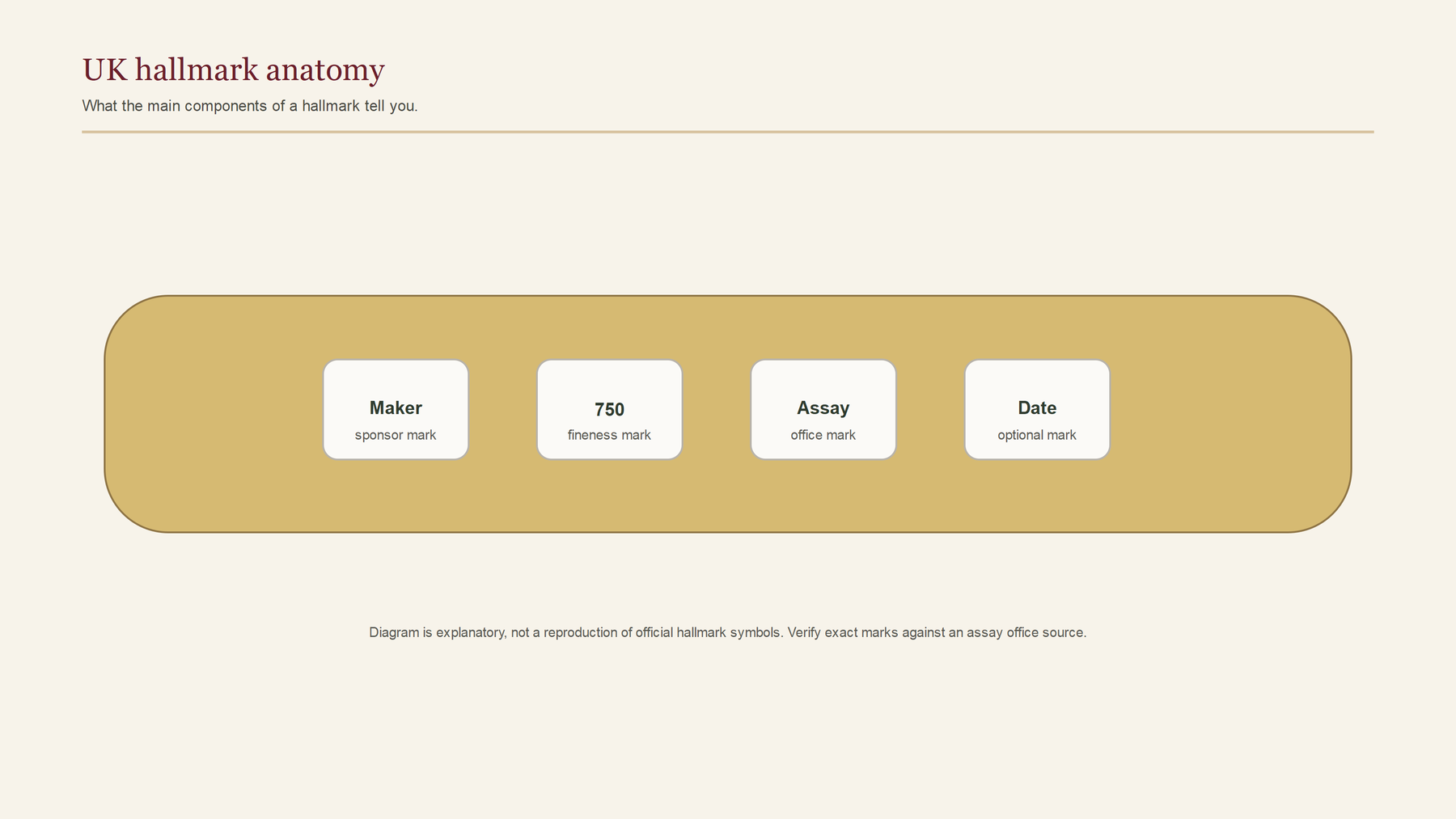
The three compulsory elements of a full UK hallmark
- Sponsor’s mark: identifies the person or company registered to submit the item for hallmarking. It does not necessarily identify the actual manufacturer.
- Fineness mark: states the precious-metal content in parts per thousand.
- Assay Office mark: identifies the Assay Office that tested and marked the article.
Traditional symbols and date letters can also appear, but Sheffield Assay Office confirms that the sponsor’s mark, fineness mark and Assay Office mark are the compulsory components of a full UK hallmark.
Common fineness numbers
| Mark | Common meaning | Approximate precious-metal content |
|---|---|---|
| 375 | 9ct gold | 37.5% gold |
| 585 | 14ct gold | 58.5% gold |
| 750 | 18ct gold | 75% gold |
| 916 | 22ct gold | 91.6% gold |
| 925 | Sterling silver | 92.5% silver |
| 950 | Common platinum fineness | 95% platinum |
Which jewellery legally needs hallmarking in the UK?
GOV.UK guidance says precious-metal articles sold as gold, silver, platinum or palladium must be hallmarked when they exceed the relevant exemption weight:
- Gold: 1 gram
- Silver: 7.78 grams
- Platinum: 0.5 gram
- Palladium: 1 gram
Below those weights, hallmarking is not compulsory under the exemption. That means a missing hallmark does not automatically prove that a very light item is fake; weight and the way the item is being sold matter.
Do not identify a ring from one number alone
A number such as 750 is useful, but a full hallmark includes surrounding shapes and other marks. Photographs can also be misleading when a tiny stamp is worn or partially visible. If the piece matters financially or historically, use an Assay Office or qualified professional rather than guessing from an online image.
What a hallmark does not tell you
A hallmark verifies precious-metal fineness. It does not tell you:
- whether the ring is well made;
- whether it will fit comfortably;
- whether the gemstones are natural or laboratory-grown;
- the quality grade of a diamond;
- the retail value of the item.
Online purchases still count
The hallmarking requirement is not limited to high-street shops. GOV.UK guidance expressly notes that the law applies whether the sale is in a shop or online.
Dealer’s Notice
Retailers selling precious-metal items in the UK are required to display the official Dealer’s Notice so customers can understand the marks. If you are buying from a UK jeweller, it is reasonable to ask where the hallmark will be placed and which Assay Office mark you should expect.
Buying checklist
- Ask the exact metal and fineness.
- Check whether the ring exceeds the hallmarking exemption weight.
- Look for the sponsor, fineness and Assay Office marks.
- Do not confuse a brand stamp with a hallmark.
- Photograph the hallmark for insurance records once you own the ring.
Official sources
- GOV.UK hallmarking guidance: https://www.gov.uk/government/publications/hallmarking-guidance-notes/hallmarking-is-the-law-guidance-summary
- Sheffield Assay Office, UK Hallmarks: https://www.assayoffice.co.uk/our-services/uk-hallmarks
- Sheffield Assay Office, Mark Identification: https://www.assayoffice.co.uk/the-library-and-the-silver-collection/mark-identification
Related guides
Watch
See hallmarking explained
A clear explainer on UK precious-metal hallmarking and why testing matters.