Rings & Jewellery
Wedding Ring Sizing Guide: How to Get the Size Right Before the Wedding
·The Wedding Ring Blog Editorial Team
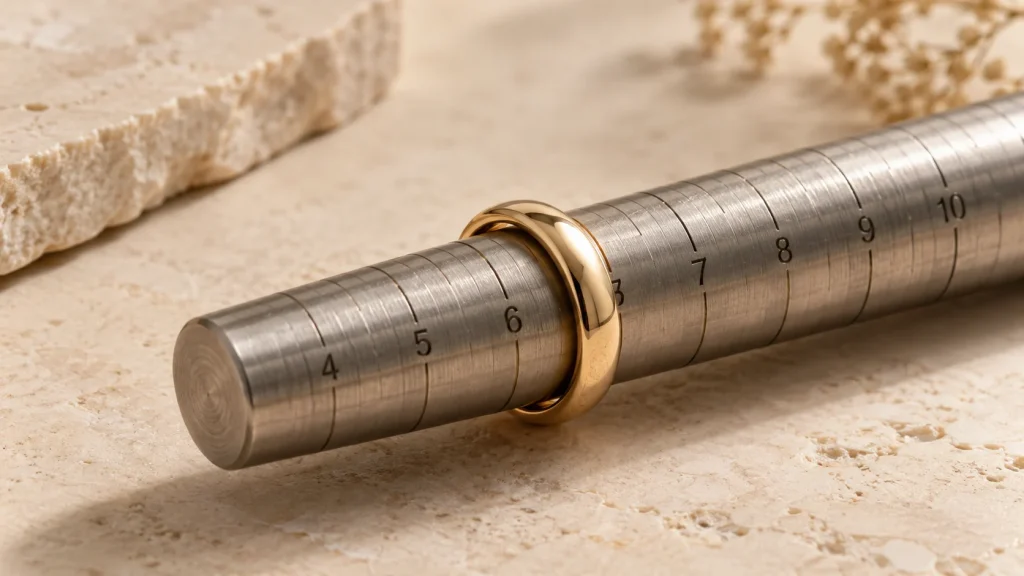
A wedding ring can match a chart and still fit badly. Fingers change with temperature and time of day, knuckles vary, wider bands feel tighter than narrow ones and an engagement-ring stack creates more total finger coverage.
For an expensive, bespoke or difficult-to-resize ring, professional sizing with the intended band width is the safest approach.
What a good fit should do
The ring should pass over the knuckle without being forced, then sit securely at the base of the finger. It should not slide off with ordinary hand movement, but it should also not leave the finger painfully compressed.
Measure more than once
Do not rely on one measurement taken after coming in from the cold, after exercise or on an unusually hot day. GIA notes that temperature, humidity, altitude and time of day can affect finger size.
Use the right sizing gauge for the ring
GIA’s professional guidance distinguishes narrow sizing gauges for rings up to about 4 mm from wide-band gauges for broader rings. If you are buying a 7 mm band, a narrow plastic loop can give you a starting point, but it does not reproduce the fit of the finished ring.
Wide bands and bridal stacks need special consideration
A wider ring or several rings stacked together contact more of the finger and often fit more snugly. Do not apply a universal “go up half a size” rule. Try a gauge or sample with similar total width and interior shape.
Your knuckle can be the real sizing problem
Some fingers have a much larger knuckle than the base where the ring sits. Sizing only for the base can make the ring impossible to put on; sizing only for the knuckle can make it spin. A jeweller may discuss sizing beads or other solutions depending on the ring.
If you are using an existing ring
An existing ring is useful only if it is worn comfortably on the same finger and hand. Right and left hands can differ. A jeweller can measure the ring on a mandrel, but an unusually wide or non-round ring needs care.
Home sizing tools: useful, not infallible
Plastic belt-style sizers and printable charts are useful for narrowing the range. They are less reliable when the intended ring is broad, unusually thick, full-eternity or made from a material that cannot be resized easily.
Avoid wrapping string or a strip of paper around your finger to choose the final size. GIA warns that these methods can be inaccurate and may overlook the knuckle. If using a printable chart, follow its scale-check instructions and treat the result as an estimate to confirm professionally.
Keep a record of your fitting
Before leaving the jeweller, note the specification that was actually tried. A size letter without the width and profile leaves out useful information when you compare another ring.
- Finger and hand: record which ring finger was measured and whether the engagement ring was worn during the fitting.
- Sample: note its width in millimetres, profile and interior shape.
- Result: write down the size and the sizing system used, plus any different result at a second appointment.
- Finished-ring plan: confirm the maker’s adjustment policy and when you will try the completed ring before engraving.
If two measurements disagree, take both records back to the jeweller rather than choosing an average. For later alterations, see our wedding-ring resizing guide.
Before committing to a ring, compare the complete cost and specification. For a pre-owned ring, use the seller checks before you pay as well as confirming fit.
Before ordering
- Confirm the exact width and profile.
- Measure more than once.
- If stacking, size with the engagement ring on.
- Ask what happens if the finished size is wrong.
- Ask whether the exact ring can be resized later.
- Do not engrave until you are confident in the size.
Rings that can be difficult to resize
Full-eternity rings, channel-set designs, complex patterned bands and many alternative-metal rings can be difficult or impractical to resize. Size accuracy matters more when the construction leaves little room for correction.
Also read the width guide and profile guide.