Rings & Jewellery
Wedding Ring Metals Explained: Gold, Platinum and Modern Alternatives
·The Wedding Ring Blog Editorial Team
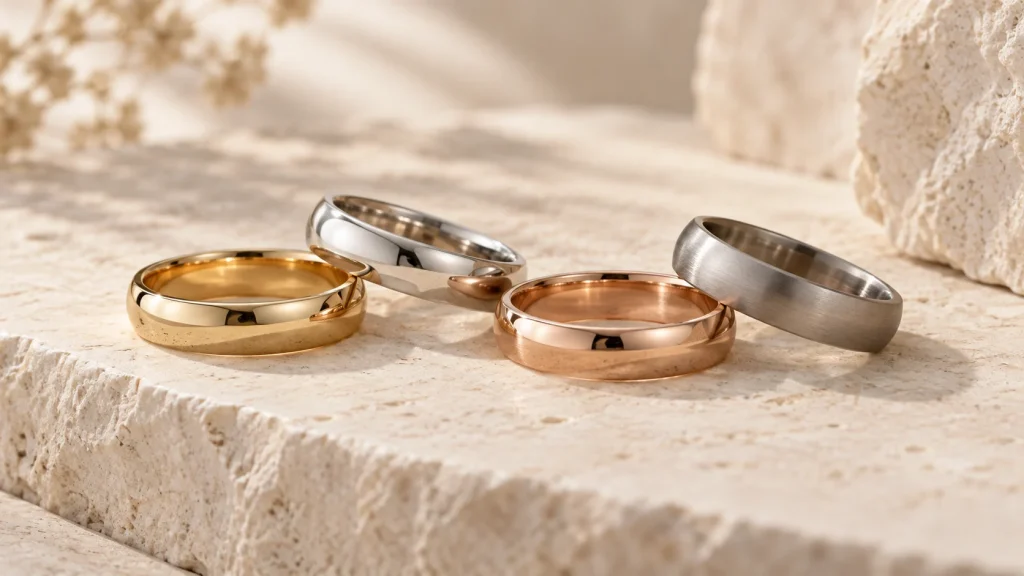
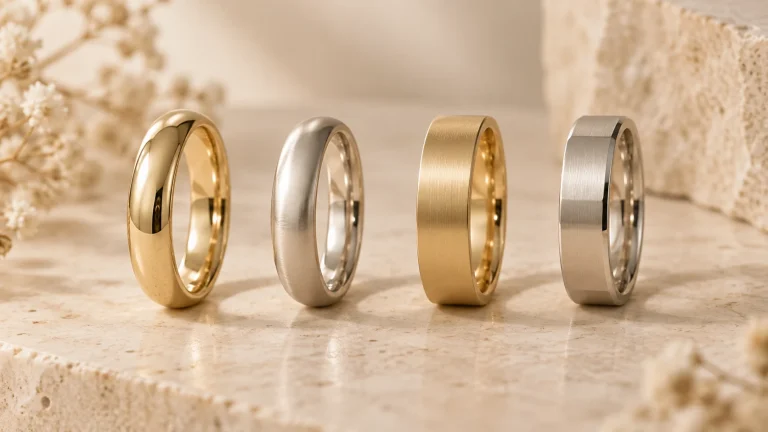
The metal is one of the few wedding-ring choices that affects almost everything else. It changes colour, weight, cost, scratch behaviour, maintenance and whether the ring can be resized easily in the future. Two bands with the same width and profile can feel completely different when one is platinum and the other is titanium.
Buying guide · Updated 16 October 2026
Choose the trade-offs you want to live with. Compare colour, weight, future resizing and maintenance before comparing prices. The alloy and construction matter as well as the metal name.
Wedding-ring metals at a glance
| Metal | Colour / feel | Everyday wear | Maintenance | Resizing |
|---|---|---|---|---|
| Platinum | Naturally white; dense and substantial | Good everyday precious metal; develops scratches/patina | Can be refinished; no rhodium plating for colour | Usually possible on plain bands; specialist work may cost more |
| 9ct gold | Yellow, white or rose depending on alloy | Common practical UK choice | Can be polished/refinished; white gold may be plated | Usually straightforward on plain bands |
| 14ct gold | Higher gold content than 9ct | Widely used internationally | Depends on colour/alloy and finish | Usually possible on plain bands |
| 18ct gold | 75% gold; rich precious-metal character | Excellent for many wedding-ring designs | White gold may need replating if a bright-white finish is desired | Usually possible on plain bands |
| 22ct gold | Very rich yellow; high gold content | Softer than common lower-carat alloys | Marks and wear are part of the decision | Design dependent |
| Palladium | Naturally white and lighter than platinum | Comfortable if you prefer lower weight | Ask about local servicing before purchase | Depends on workshop capability |
| Titanium | Grey and very light | Corrosion resistant; low weight is the standout feature | Low routine maintenance | Often limited |
| Tungsten carbide | Grey; noticeably heavy | Extremely scratch resistant but can fracture under severe impact | Low routine maintenance | Normally replaced rather than conventionally resized |
| Stainless steel | Grey-white; moderate weight | Hard-wearing and affordable | Simple cleaning; specialist finishes vary | Often limited |
Colour is only the beginning
Most wedding-ring gold is alloyed with other metals. The carat tells you the proportion of gold, not a universal quality score. In the UK, common fineness marks include 375 for 9ct, 585 for 14ct, 750 for 18ct and 916 for 22ct.
Yellow gold
The exact tone changes with carat and alloy. Compare the actual bands rather than relying on a colour name.
Rose gold
Copper-rich alloying creates the rose colour. Ask for the exact metal and fineness of the piece.
White gold
Whiter alloying metals create the base colour; rhodium plating is common. Ask what refinishing involves.
Do not treat the phrase “9ct is harder” or “18ct is softer” as the whole decision. Alloy recipes differ. The shape, thickness and manufacture of the finished band also affect how it behaves.
Platinum: naturally white and noticeably heavier
Platinum is popular for wedding and engagement jewellery because it is naturally white and dense. That density is immediately noticeable in a broad band. Some people love the substantial feel; others prefer a lighter ring.
Platinum develops surface marks and a characteristic patina with wear. That is not the same as the ring “losing” its colour. The surface can be professionally refinished if a brighter appearance is preferred.
For a direct comparison, read Platinum vs White Gold Wedding Rings.
Palladium: still worth understanding, even if you see it less often
Palladium is a platinum-group metal with a naturally white colour and lower density than platinum. It can be an attractive ring metal, but in 2026 the practical question is servicing. Availability is less widespread than gold or platinum, so ask whether the jeweller can resize and refinish the exact ring later.
Titanium, tungsten and stainless steel
Alternative metals can be excellent when their physical properties suit the buyer. The mistake is assuming “durable” means the same thing for all three.
Titanium
exceptionally light and corrosion resistant. It is useful for people who dislike the feel of a heavy ring, but conventional resizing is often limited.
Tungsten carbide
extremely hard and highly scratch resistant. Its hardness also means it behaves differently from ductile precious metals under a hard impact; replacement rather than resizing is normally the practical route.
Stainless steel
affordable, hard-wearing and available in many modern finishes. As with titanium and tungsten, ask what happens if your finger size changes.
Read the full alternative-metal comparison.
What about silver?
Sterling silver can make attractive jewellery, but it is softer and more prone to tarnish than many common wedding-ring choices. That does not make it unsuitable in every case; it means a buyer should be realistic about daily wear and maintenance, particularly for a ring expected to be worn continuously for decades.
Sensitive skin: ask about the alloy, not just the headline metal
A label such as “gold” or “white gold” does not reveal every alloying metal. If you have a history of reacting to jewellery, ask the jeweller for the exact metal and fineness, whether nickel is present and whether a white finish is plated. Persistent skin reactions should be assessed by an appropriate health professional rather than diagnosed from an article.
UK hallmarking
In the UK, gold, silver, platinum and palladium articles above the relevant exemption weights must be hallmarked when sold as those precious metals. GOV.UK lists the thresholds as 1 g for gold, 7.78 g for silver, 0.5 g for platinum and 1 g for palladium.
A hallmark verifies precious-metal fineness. It does not grade workmanship, comfort or gemstone quality. See UK Wedding Ring Hallmarks Explained.
Five questions that make the metal decision easier
- Do I like a light ring, a moderate weight or a very substantial feel?
- Do I want a naturally white metal, or am I happy with a plated white-gold finish?
- How important is future resizing?
- Am I comfortable with scratches and patina, or do I expect regular refinishing?
- Can a local jeweller service this exact metal and design in ten or twenty years?
Sources & further reading
- GIA: ring metals for everyday wear
- GOV.UK: hallmarking guidance
- Sheffield Assay Office: UK hallmarks
Next compare widths, profiles, long-term care and the sensitive-skin guide, or return to the Wedding Ring Guide.